
Think of exercise not as a supplement to Parkinson’s treatment; think of it as treatment itself. That’s not a motivational reframe; it’s what the research actually says. For people with Parkinson’s, movement is one of the most evidence-backed interventions available, with effects on symptom progression, mood, balance, and brain health that no pill fully replicates.
Summer changes the equation in both directions. Longer days, more daylight, social opportunities, and a natural pull outdoors all make it easier to stay active. But Texas heat brings real risks for Parkinson’s patients, whose autonomic nervous systems often don’t regulate temperature the way a healthy person does. Getting this season right means understanding both sides: what to do and how to do it safely.
Why Exercise Is One Of The Most Powerful Parkinson’s Treatments
Parkinson’s and exercise have been studied together for decades, and the findings keep pointing in the same direction: consistent physical activity improves balance, reduces motor symptom severity, supports mood, and may slow the disease’s progression in ways that go beyond what medication alone achieves.
A landmark finding from the Parkinson’s Outcomes Project, one of the largest clinical studies of the disease, found that people who exercised at least 2.5 hours per week experienced a measurably slower decline in quality of life compared to those who started later or exercised less. That’s not a marginal difference. It’s the kind of result that should change how every patient approaches their weekly schedule.
Exercise for Parkinson’s patients works as a complement to medication, not a replacement. Levodopa, dopamine agonists, and other treatments manage symptoms chemically; exercise targets the underlying neural and physical systems – strength, balance, gait coordination, and cardiovascular health – in ways that pharmacology can’t fully address. The combination consistently produces better outcomes than either alone.
How Regular Movement Slows Parkinson’s Progression
The mechanism behind the best exercise for Parkinson’s isn’t just “movement is healthy.” It’s specific and neurological. Physical activity, particularly aerobic exercise, raises levels of brain-derived neurotrophic factor (BDNF), a protein that supports the survival and growth of neurons. In the context of a disease defined by progressive neuron loss, this matters enormously.
A 2024 systematic review and meta-analysis in Brain Sciences analyzed five trials involving 216 patients with Parkinson’s. They found that exercise significantly increased serum BDNF levels (standardized mean difference of 1.20) and that these increases correlated with measurable improvements in balance scores and motor function ratings (Brain Sci. 2024). Exercise also improves dopamine receptor function and promotes neural plasticity, the brain’s ability to reorganize and form new connections, which translates directly into better coordination and reduced fall risk over time.
Heat Safety Tips Every Parkinson’s Patient Needs
Summer’s biggest risk for Parkinson’s summer activities is heat. Parkinson’s disease affects the autonomic nervous system, which governs temperature regulation. Many patients sweat less efficiently than they should, which means their bodies can’t cool down as quickly when temperatures rise. Heat illness can develop faster and at lower temperatures than most patients and families expect.
Practical rules for summer exercise:
- Exercise in the early morning. Before 9 am, temperatures are lower, humidity hasn’t peaked, and your medication is often at its most effective “on” state for the day. This is the ideal exercise window.
- Bring water and drink before you’re thirsty. By the time thirst kicks in, you’re already mildly dehydrated. For Parkinson’s patients, this matters because dehydration worsens motor symptoms and increases the risk of dizziness.
- Move indoors from 11 am to 4 pm. This is peak heat in the Texas summer. Group fitness classes, gym workouts, and water aerobics in climate-controlled pools fill this window perfectly.
- Know the warning signs. Feeling flushed, unusually weak, confused, or stopping sweating when you should be sweating are signals to stop immediately, get to a cool space, and hydrate.
6 Best Summer Activities For Parkinson’s Patients
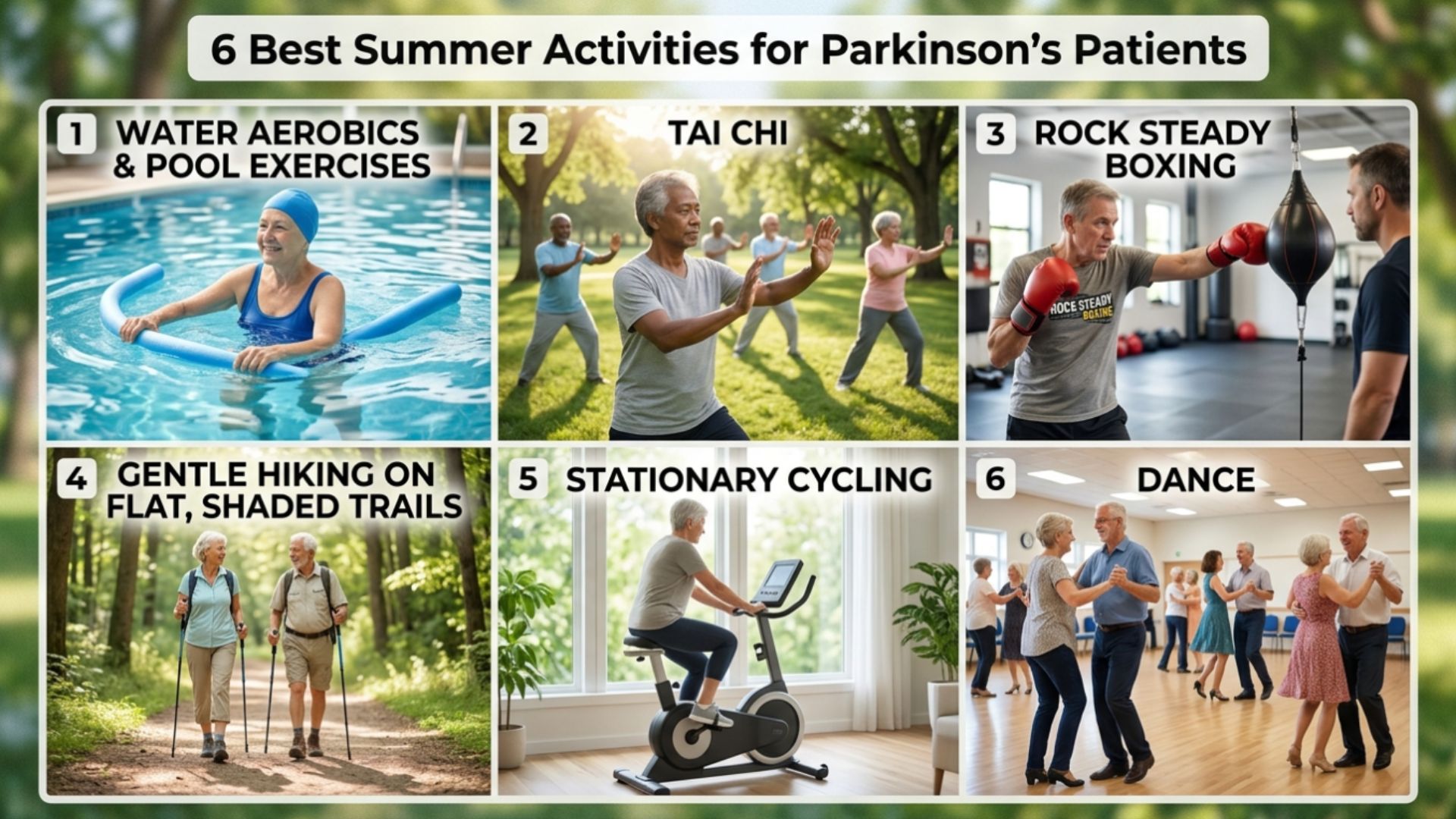
The best Parkinson’s summer activities, and indoor ones, share a few qualities: they’re enjoyable enough to sustain, they address Parkinson’s specific vulnerabilities (balance, gait, coordination), and they can be scaled to different disease stages. Here are six that consistently deliver.
- Water aerobics and pool exercises. Water is the ideal summer environment for Parkinson’s patients. The buoyancy reduces fall risk to nearly zero, the resistance builds strength, and the cool temperature automatically manages the heat safety issue. Many community pools and Y facilities offer water aerobics classes – these are worth prioritizing as a primary summer activity.
- Tai chi. Tai chi for Parkinson’s has one of the strongest evidence bases of any exercise modality for this population. A 2019 meta-analysis of five RCTs in Parkinson’s disease found consistent improvements in Berg Balance Scale scores and reduced fall rates among patients who practiced tai chi regularly (Liu et al., Parkinson’s Dis. 2019). The slow, deliberate movements train exactly the balance and coordination pathways that Parkinson’s erodes, and indoor tai chi classes are perfect for summer heat.
- Rock Steady Boxing. Boxing-style programs specifically designed for Parkinson’s patients (Rock Steady Boxing is the most widely available) have become one of the most popular and well-studied options. They build strength, coordination, reaction time, and confidence, and the group environment adds accountability and social connection that improve long-term adherence.
- Gentle hiking on flat, shaded trails. Among the best outdoor activities for Parkinson’s patients in earlier disease stages, early-morning hikes on paved or smooth surfaces offer cardiovascular benefits, exposure to nature (which genuinely supports mood), and the gait practice that Parkinson’s patients specifically need. Always go with a companion, and choose trails with low fall risk.
- Stationary cycling. Research has found that cycling – particularly at a pace slightly above the patient’s self-selected speed – produces notable improvements in Parkinson’s motor symptoms. An indoor stationary bike eliminates heat exposure and fall risk while delivering real cardiovascular and neurological benefits.
- Dance. Tango, in particular, has been well studied in Parkinson’s disease and consistently improves gait, balance, and freezing episodes. Dance also addresses something other exercises don’t as directly: rhythm. Rhythmic cueing helps Parkinson’s patients initiate and maintain movement more smoothly. Many studios offer Parkinson’s-specific classes, and indoor dance is perfectly suited to summer.
Building A Weekly Routine That Actually Sticks
The research on Parkinson’s and exercise is clear that variety matters more than intensity, and consistency matters more than both. Here’s a practical framework for a sustainable summer week:
- 3 aerobic days (Monday / Wednesday / Friday): 30-45 minutes of walking, cycling, water aerobics, or dance. Aim for the morning “on” window when medication is at its most effective. These sessions build cardiovascular fitness and support the BDNF response.
- 2 strength days (Tuesday / Thursday): Light resistance training – bands, body weight, or light weights – targeting legs, core, and upper body. Strength work reduces fall risk and counters the muscle rigidity that characterizes Parkinson’s.
- 2 balance and flexibility days (Saturday / Sunday): Tai chi, yoga, or targeted balance exercises. These sessions are lower intensity and can comfortably run into mid-morning without heat risk.
A few practical notes that make a real difference:
- Time workouts to your “on” periods. Parkinson’s medications have peaks and troughs. Most patients feel best and most coordinated 45-90 minutes after their morning dose. Schedule workouts then, not when medication is wearing off.
- Group classes improve adherence dramatically. Solo exercise routines are harder to maintain. Rock Steady Boxing, tai chi classes, water aerobics groups, and dance classes all provide the social accountability that keeps people showing up week after week.
- Track progress in a simple journal. Note how you felt before and after, which symptoms seemed better or worse, and what you did. This information is also useful for your neurologist; it helps with medication timing adjustments and identifying what’s working.
- Improvements in Parkinson’s and exercise are often gradual and non-linear. Some weeks are better than others. The goal is the cumulative effect over months, not perfection on any given day.
Personalized Parkinson’s Care At Lone Star Neurology
The best exercise plan for any Parkinson’s patient is one designed with a neurologist who knows your medication schedule, your specific motor symptoms, your disease stage, and where your balance and fall risk actually stand.
At Lone Star Neurology, the Parkinson’s treatment Texas patients receive from our movement disorder specialists goes well beyond medication management. Our team integrates exercise guidance into every treatment plan because we know from the evidence that movement is among the most powerful tools for slowing functional decline and improving daily quality of life.
What you can expect when you work with us:
- Movement disorder specialist evaluation – fellowship-trained neurologists who focus specifically on Parkinson’s and related conditions
- Medication timing optimization – because when you take your medication directly affects when exercise will be most effective and safe
- Physical and occupational therapy referrals – coordinated with our neurological evaluation to address your specific gait, balance, and strengthening needs
- DaTscan imaging and diagnostic precision when diagnosis is uncertain
Call us at 214-619-1910 or schedule online to connect with a movement disorder specialist.