

If you have restless legs syndrome, you already know summer has its own special cruelty. The worst hours tend to be somewhere between 10 pm and 2 am, when the bedroom is still holding the day’s heat, the sheets feel suffocating, and your legs simply will not cooperate. The crawling, tingling, irresistible urge to move kicks in exactly when you need to be still and sleeping.
RLS summer flares have a real physiological basis, and understanding what’s driving them makes a meaningful difference in managing them. This guide covers the science behind why heat intensifies symptoms, seven practical strategies that actually help, and when it’s time to move beyond home management and see a specialist.
How Summer Heat Makes Restless Legs Syndrome Worse
Restless legs syndrome, formally known as Willis-Ekbom disease, is a neurological sensorimotor disorder driven by disrupted dopamine signaling in the brain, often compounded by underlying iron insufficiency. In most patients, symptoms follow a predictable circadian pattern: they worsen in the evening and at night, ease up in the early morning, and are almost absent during the day.
Summer complicates this pattern in a few distinct ways. Heat causes blood vessels to dilate, increasing circulation to the skin and limbs. For people with RLS, that change in peripheral blood flow can amplify the uncomfortable sensations in the legs. Elevated body temperature also disrupts sleep architecture; you get less deep sleep, more fragmented rest, and an overall state of physiological stress that makes the nervous system more reactive.
The result is a vicious cycle: hot nights and RLS feed each other. Poor sleep from heat raises baseline physiological arousal, which lowers your brain’s dopamine reserves, which makes RLS symptoms more intense the following night, which makes sleep harder still. On top of that, summer often brings dehydration, later nights, more alcohol at social events, and irregular schedules, all of which are known RLS aggravators.
The Role Of Iron And Dopamine In RLS
To understand why RLS is worse in summer, it helps to understand what’s happening at the neurochemical level. The condition’s core mechanism involves iron deficiency in the brain, specifically in regions that regulate the dopamine system, which governs movement and sensation.
Here’s what makes this clinically tricky: many RLS patients have perfectly normal blood ferritin levels, yet still have insufficient iron in the brain. Research published in NeuroImage: Clinical confirmed that brain iron deficiency in RLS exists independently of peripheral iron stores – patients can have normal serum ferritin while showing reduced iron concentrations in key brain regions. This is exactly why a normal blood test doesn’t rule out iron deficiency as a contributor to RLS, and why some patients respond to iron supplementation even when their labs look fine.
Iron is a required cofactor in the production of dopamine. When brain iron levels drop, dopamine signaling in the pathways that regulate sensorimotor function becomes dysregulated. The body compensates in ways that create the characteristic nighttime symptom surge, and summer’s effect on sleep and hydration can tip this already-precarious balance further into dysfunction.
Why Nighttime Triggers Are Strongest In Summer
Even without summer heat, RLS summer symptoms follow a natural evening peak. Dopamine levels in the brain decline as part of the normal circadian rhythm overnight, which is part of why RLS almost universally worsens at night. The brain is running low on the very neurotransmitter that keeps symptoms in check during the day.
Layer summer’s specific triggers on top of that:
- Dehydration concentrates the blood and affects circulation, which can worsen leg sensations. In Texas summer heat, mild dehydration can accumulate over the course of a day without notice.
- Screen use before bed is a year-round problem, but summer’s longer, more social evenings tend to mean more late-night scrolling. Blue light suppresses melatonin and delays sleep onset, giving RLS more window to activate before you’re properly asleep.
- Late dinners and alcohol. Summer social rhythms often push dinner later and add wine or beer to the evening. Both alcohol and eating late can worsen RLS independently; together, they’re a reliable trigger for a rough night.
The combination of a naturally lower dopamine floor at night plus heat-disrupted sleep plus summer lifestyle habits creates conditions that can make RLS feel dramatically worse from June through August even if the underlying condition hasn’t changed.
7 Cooling Strategies For Calmer, Quieter Nights
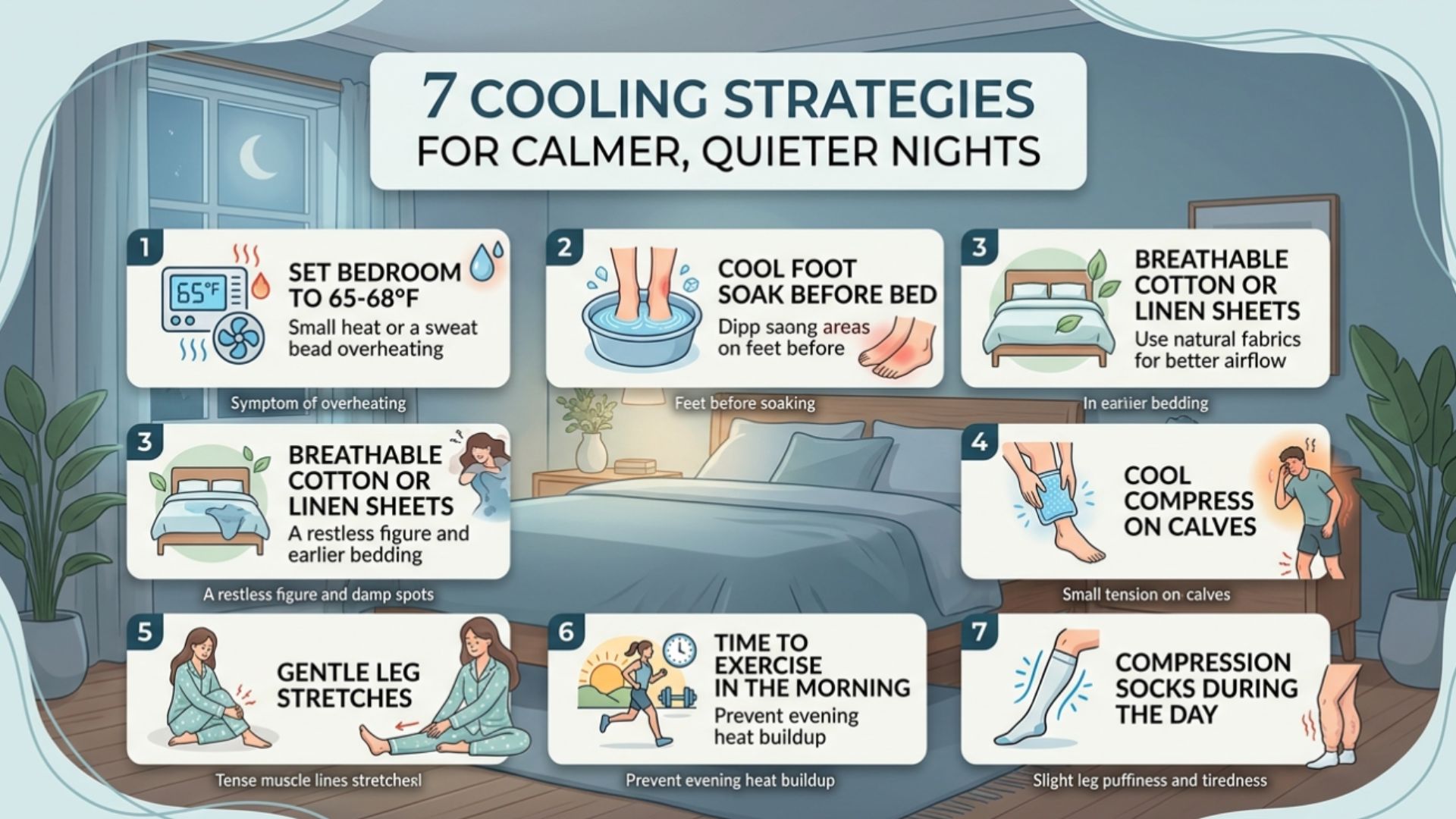
Managing restless leg relief during summer starts with the environment. These seven strategies address the heat-related triggers most directly:
- Set the bedroom to 65-68°F. This is the range where core body temperature drops most efficiently for sleep. If you can only fix one thing, fix the room temperature.
- Cool foot soak before bed. Soaking your feet and lower legs in cool (not ice cold) water for 10-15 minutes before sleep can lower local skin temperature and ease the irritated sensations in the legs that precede RLS episodes.
- Breathable cotton or linen sheets. Synthetic materials trap heat. Lightweight cotton or linen allows airflow and prevents the overnight heat buildup that can trigger or worsen symptoms.
- Cool compress on calves. A damp, cool towel wrapped around the lower legs while winding down can be remarkably effective for calming the restless sensations before sleep onset.
- Gentle leg stretches. Calf raises, hamstring stretches, and slow walking for 10 minutes before bed can temporarily quiet the urge-to-move sensation; that is enough to fall asleep. Don’t push into intense exercise, which can backfire.
- Time to exercise in the morning. Regular physical activity genuinely helps RLS, but vigorous evening exercise, especially in summer heat, raises core body temperature and can worsen symptoms. Shift workouts to mornings.
- Compression socks during the day. Graduated compression helps manage blood flow in the legs during daytime hours and may reduce symptom intensity in the evening. Remove them before bed.
What not to do: Caffeine after noon reliably worsens RLS for most people – cut it off earlier than you think you need to. Hot baths or showers right before bed raise core temperature at exactly the wrong moment. Skip them, or switch to a cool shower instead.
Diet And Lifestyle Changes That Reduce RLS Episodes
Managing restless legs syndrome over the long term means looking at the underlying factors that make the nervous system more reactive, not just the night-to-night triggers:
- Iron and ferritin testing. Ask your doctor for a serum ferritin level. For RLS, many neurologists aim for ferritin above 75-100 µg/L – higher than the general “normal” range. A network meta-analysis in Frontiers in Neuroscience confirmed that iron supplementation reduces RLS symptom severity in patients with ferritin below 45 µg/L. If your ferritin is low or borderline, this is often the highest-yield intervention available.
- Iron-rich foods. Red meat, lentils, spinach, pumpkin seeds, and tofu are practical dietary additions. Pairing plant-based iron sources with vitamin C improves absorption.
- Alcohol and caffeine. Both worsen RLS for the majority of patients. Alcohol may feel relaxing, but fragments sleep and suppresses dopamine; caffeine keeps the nervous system in a state that makes symptoms worse. Reducing or eliminating both is one of the most impactful lifestyle changes for many patients.
- Consistent sleep schedule. The circadian disruption of irregular sleep timing is an underrated RLS trigger. A stable wake-up time, even on weekends, anchors your dopamine rhythm and reduces symptom variability.
- Medication review. Several commonly used medications worsen RLS: first-generation antihistamines (diphenhydramine – found in most OTC sleep aids and allergy medications), many antidepressants (particularly SSRIs and TCAs), and dopamine antagonists used for nausea. If you take any of these regularly, this is worth a specific conversation with your neurologist.
Get Real RLS Relief At Lone Star Neurology
Home strategies make a real difference for mild-to-moderate RLS, but they have a ceiling effect. When symptoms disrupt sleep most nights, affect your mood and cognitive function during the day, or simply don’t respond to lifestyle changes, it’s time for a proper medical evaluation.
RLS treatment Texas patients rely on at Lone Star Neurology starts with understanding the full picture: iron studies (including ferritin), a review of any aggravating medications, and a thorough neurological assessment to confirm the diagnosis and rule out mimics. From there, treatment is matched to severity and individual factors:
- Gabapentinoids (gabapentin enacarbil, pregabalin) are now considered first-line pharmacologic treatment for RLS in the updated 2025 AASM guidelines, offering effective symptom control with a better long-term side-effect profile than older options.
- Dopamine agonists (pramipexole, ropinirole) remain appropriate in some cases but require careful management due to the risk of augmentation – a paradoxical worsening of symptoms with long-term use that we monitor for closely.
- Iron infusions – intravenous iron in select patients with documented deficiency or those who don’t absorb oral iron adequately – can produce significant and lasting improvement.
With 17 locations across the DFW area, we make it possible to be seen quickly, because managing restless legs syndrome through a Texas summer shouldn’t mean adding “wait months for an appointment” to the list of things keeping you up at night.
📞 Call us at 214-619-1910 or schedule online to request an appointment with an RLS specialist.

 (124 votes, average: 4.79 out of 5)
 Loading...






I've given up... the stress her office staff has put me through is just not worth it. You can do so much better, please clean house, either change out your office staff, or find a way for them to be more efficient please. You have to do something. This is not how you want to run your practice. It leaves a very bad impression on your business.
Please, leave your review
Write a comment: