

Most pain follows a predictable arc: injury happens, healing occurs, pain subsides. Complex regional pain syndrome breaks that arc entirely. The injury heals, or at least appears to, but the pain doesn’t leave. It intensifies and spreads. A wrist fracture from months ago now produces burning so severe that a shirt sleeve touching the skin is unbearable. It is a documented neurological dysfunction in which the nervous system becomes locked in a state of amplified, self-sustaining pain.
At Lone Star Neurology, we evaluate patients across 18 Texas locations who have often spent months in the wrong treatment lane before a neurologist finally maps the full picture. Earlier recognition consistently leads to better outcomes. This article gives you the information that makes earlier recognition possible.
What CRPS Is and Why It Develops
Complex regional pain syndrome is divided into two distinct types. CRPS-I (historically called reflex sympathetic dystrophy) develops without confirmed damage to a specific nerve, typically following fractures, surgery, or prolonged immobilization. CRPS-II involves documented nerve injury and tends to present with more localized, defined pain patterns.
What both types share is the core mechanism: the central and peripheral nervous systems begin processing pain signals incorrectly. Instead of pain diminishing as tissue heals, the nervous system amplifies and perpetuates it – as if an alarm that should have been silenced is stuck in the on position. Sympathetic nervous system dysfunction drives the skin color changes, temperature instability, and swelling that distinguish this condition from standard chronic pain.
The most common triggers include distal limb fractures, surgical procedures, prolonged casting, and soft tissue injuries, particularly to the hands or feet. Notably, the severity of the initial injury doesn’t predict who develops CRPS. Minor injuries can trigger disproportionate neurological responses in susceptible individuals.
Recognizing the Symptoms of CRPS
CRPS symptoms are wide-ranging and often fluctuate, which is part of why the condition is so frequently misidentified in its early stages.
The defining feature is severe burning or throbbing pain, typically affecting one limb, that is disproportionate to any visible tissue damage. Complex regional pain syndrome symptoms also include: dramatic skin color changes shifting between red, blue, and pale; temperature asymmetry between the affected and unaffected limb; swelling with a shiny or thin skin appearance; increased sweating in the affected area; and allodynia – the hallmark phenomenon where ordinary stimuli like light touch, clothing contact, or air movement cause sharp, intense pain.
Because pain restricts movement, secondary problems compound quickly: muscle weakness, joint stiffness, and decreased range of motion develop not from the original injury but from protective guarding and disuse. CRPS symptoms that go unaddressed have a well-documented tendency to worsen over time, not stabilize.
How CRPS Spreads and Progresses
One of the most important, and least discussed, features of this condition is its capacity to expand beyond the original injury site.
Symptoms of CRPS spreading follow several patterns:
- Contiguous spread (moving up the same limb)
- Mirror spread (appearing in the corresponding limb on the opposite side)
- Independent spread to an entirely different body region
A patient who develops CRPS in one hand after a Colles fracture may, months later, notice burning and skin changes in the opposite hand or foot. This is not a new injury. It reflects central sensitization – the nervous system itself becoming hyperexcitable beyond the original insult.
The disease also progresses through clinical stages. Early on, burning pain, swelling, and temperature changes dominate. As the condition advances, muscle weakness, nail and hair changes, and joint stiffness emerge. In advanced stages, atrophy and severe mobility loss can result. Not every patient progresses through all stages, and the timeline is not predictable – which is exactly why early intervention matters rather than monitoring from a distance.
The neurological mechanisms underlying this kind of central sensitization are explored in detail in a piece on brain anatomy and nervous system function – useful context for patients trying to understand why pain persists after the body appears to have healed.
How Neurologists Diagnose CRPS
There is no single definitive test for complex regional pain syndrome. Diagnosis is clinical, built from a structured assessment of symptoms, physical findings, and exclusion of other causes.
Neurologists use the Budapest Criteria, a validated framework that requires specific combinations of reported symptoms and observed signs across pain, sensory, vasomotor, sudomotor/edema, and motor/trophic categories. Temperature measurement between limbs is particularly meaningful: a consistent asymmetry of more than 1°C supports the diagnosis significantly.
MRI is used not to confirm CRPS directly but to evaluate soft tissue changes, rule out structural pathology, and document edema patterns that correlate with sympathetically mediated inflammation.
Sympathetic nerve blocks serve a dual purpose: therapeutic in that they can reduce pain temporarily, and diagnostic in that a meaningful response supports the clinical suspicion. All advanced diagnostic procedures used in complex neurological evaluations are outlined on the tests and procedures page.
Treatment Options for CRPS
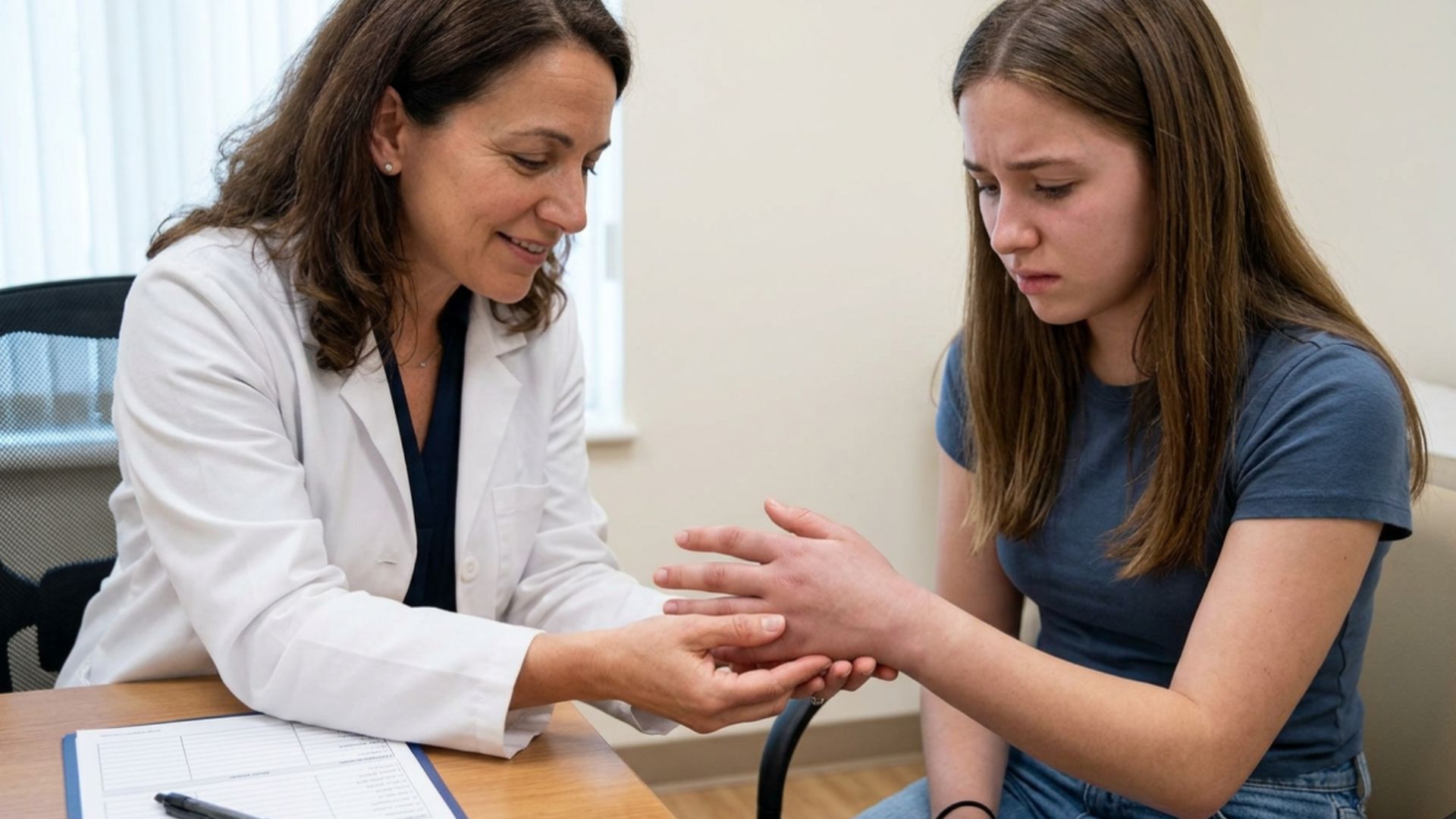 CRPS treatment works best when started early and structured as a multi-modal program – not a single intervention applied in isolation.
Complex regional pain syndrome treatment begins with active physical and occupational rehabilitation. This is not optional. Movement is medicine in CRPS: maintaining range of motion, rebuilding muscle function, and desensitizing the nervous system through graded exposure all depend on structured, progressive activity. The instinct to rest and protect the limb worsens outcomes – guided movement improves them.
Complex regional pain syndrome medication is selected based on the specific pain profile. Neuropathic agents (gabapentin, pregabalin) target the aberrant nerve signaling directly. Low-dose naltrexone has emerging evidence in centrally mediated pain syndromes. Corticosteroids help manage inflammatory flares. Patients with sympathetically maintained pain – where temperature and skin changes are prominent – often benefit from targeted interventions not available in standard pain management settings. The neuropathy treatment program at Lone Star Neurology addresses the nerve-mediated pain mechanisms that define this condition.
CRPS treatment in resistant cases escalates to sympathetic nerve blockade series, ketamine infusion protocols, or spinal cord stimulation – a procedure with strong evidence for CRPS treatment when pharmacological and rehabilitative approaches have not produced adequate relief. These decisions require specialist-level neurological evaluation, not a trial-and-error approach.
Living with CRPS and Long-Term Management
Managing complex regional pain syndrome over time requires accepting that the goal is functional restoration and symptom control – not necessarily complete pain elimination, particularly in established cases.
Practical strategies matter considerably here. Pacing – alternating activity with planned rest rather than powering through until a flare is triggered – reduces peak symptom severity and helps patients stay more consistently functional. Temperature triggers, stress responses, and overexertion are the most common flare precipitants, and anticipating them is more effective than reacting after the fact.
Psychological support is not an adjunct, it is part of the treatment architecture. Chronic pain rewires emotional processing, and working with a psychologist experienced in chronic pain adaptation meaningfully improves both mood outcomes and pain coping. Patients who engage with psychological support alongside medical management consistently report better quality of life scores than those who address only the physical dimension.
The vascular and autonomic features of CRPS – the skin color cycling, temperature dysregulation – share some mechanistic territory with conditions like Raynaud’s, where blood vessel and autonomic nervous system dysfunction drive symptoms. A look at PAD and Raynaud’s disease offers useful context for patients navigating this overlap.
When to See a Neurologist for Unexplained Limb Pain
The answer-first version: if limb pain is worsening rather than improving weeks after an injury, and it’s accompanied by skin changes, temperature asymmetry, or allodynia – see a neurologist now, not after another course of physical therapy.
Several specific presentations signal that neurological evaluation is overdue: burning or throbbing pain that is disproportionate to the original injury; skin that cycles between red, blue, and pale without explanation; swelling that persists well beyond the expected healing period; and pain provoked by touch, clothing, or temperature that should not be painful at all.
At Lone Star Neurology, our neurology team includes providers experienced in chronic pain syndromes, neuropathic conditions, and the diagnostic precision that distinguishing CRPS from other causes of limb pain requires. Same-day appointments are available across 18 Texas locations. Book an evaluation today or call 214-619-1910.
FAQ
Can CRPS spread to other parts of the body?
Yes, contiguous spread up the same limb, mirror spread to the opposite limb, and independent spread to a different region are all documented. Monitoring for new areas of involvement is part of ongoing management.
Is complex regional pain syndrome permanent?
Not necessarily. Early treatment is associated with significantly better outcomes, including full remission in some patients. Advanced cases with established atrophy carry a less favorable prognosis.
What is the difference between CRPS type 1 and type 2?
CRPS-I (formerly reflex sympathetic dystrophy) occurs without documented nerve injury. CRPS-II involves confirmed damage to a specific peripheral nerve. Both share the core features of disproportionate pain and autonomic dysfunction.
Can CRPS be triggered by a minor injury?
Yes. The nervous system’s response is disproportionate to the injury’s severity. Even a minor sprain, injection, or brief immobilization can initiate the cascade in susceptible individuals.
Does spinal cord stimulation help with CRPS pain?
For carefully selected patients who haven’t responded adequately to conservative CRPS treatment, spinal cord stimulation has strong evidence for meaningful pain reduction and functional improvement.

 (86 votes, average: 4.78 out of 5)
 Loading...







I've given up... the stress her office staff has put me through is just not worth it. You can do so much better, please clean house, either change out your office staff, or find a way for them to be more efficient please. You have to do something. This is not how you want to run your practice. It leaves a very bad impression on your business.
Please, leave your review
Write a comment: