

There is a particular kind of terror in waking up with one side of your body not responding. The arm feels heavy. Speech comes out wrong. Vision has gone strange at the edges. For someone who has never experienced this before, the instinct is immediate: this is a stroke. Call 911.
Sometimes that instinct is right. But for people with hemiplegic migraine, these episodes – terrifying as they are – are not a vascular emergency. They are neurological in nature, and the difference matters enormously for how they are treated. At Lone Star Neurology, we evaluate patients across 18 Texas locations who have spent months, sometimes years, in diagnostic limbo: told it’s anxiety, told it’s atypical migraine, told to “see how it goes.” This article is for those patients.
What a Hemiplegic Migraine Looks Like
Hemiplegic migraine symptoms develop in phases, not all at once, and that staging is part of what distinguishes them clinically from stroke, though not reliably enough for anyone to self-diagnose in the moment.
The defining feature is motor weakness or temporary paralysis on one side of the body. This usually develops as part of the aura, before the headache itself arrives, and can last anywhere from minutes to hours. Visual disturbances – flashes, blurring, loss of part of the visual field – often accompany it. Some patients experience sensory symptoms, such as tingling or numbness spreading down one arm or leg.
What makes this a complex migraine rather than a standard aura migraine is the involvement of motor function. Speech can become slow, effortful, or incoherent, which, understandably, adds to the alarm. Then comes the headache: typically severe, throbbing, and prolonged.
The honest clinical reality is that a first episode of hemiplegic migraine symptoms is indistinguishable from stroke without imaging. Anyone experiencing sudden unilateral weakness with headache – even someone with a known diagnosis – should be evaluated urgently. The stroke evaluation program at Lone Star Neurology handles exactly this kind of presentation.
Familial vs Sporadic Hemiplegic Migraine
Hemiplegic migraine comes in two genetically distinct forms, and the distinction isn’t just academic; it shapes how the diagnosis is confirmed and how family members should be counseled.
Familial hemiplegic migraine is inherited through autosomal dominant mutations, most commonly in three genes: CACNA1A, ATP1A2, and SCN1A. These genes regulate ion channels in nerve and muscle cells, and when they malfunction, they trigger the cascade of neurological events that defines an attack. If a parent or sibling has the same episodic symptoms – motor weakness, visual aura, severe headache – genetic testing becomes a genuinely useful part of the workup.
Sporadic hemiplegic migraine presents identically but occurs without any identifiable family history. The absence of a genetic link doesn’t make it less real or less disabling; it simply means the diagnostic picture has to be assembled more carefully. Both forms require ongoing neurological monitoring, and both require a neurologist who understands the nuances rather than a general approach built for typical migraine.
What Triggers an Episode
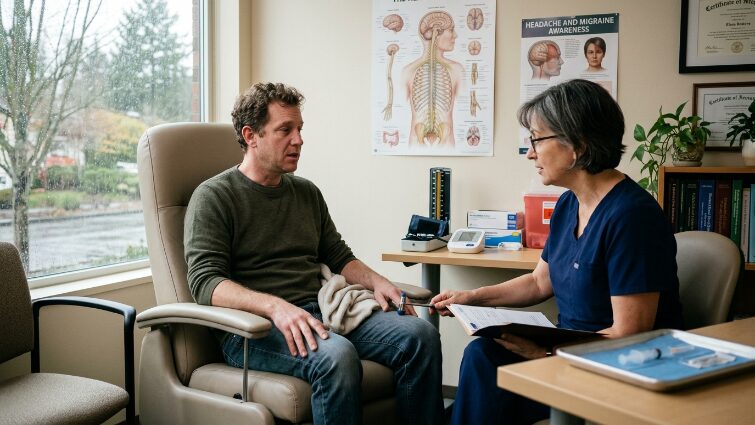
Triggers in hemiplegic migraine overlap with other migraine types, but the stakes here are higher, because an attack doesn’t just mean a bad headache. It means hours of motor symptoms that can be indistinguishable from a stroke.
Emotional stress is consistently among the most reported triggers. Sleep disruption raises attack frequency significantly. Hormonal fluctuations, particularly around menstruation, are especially relevant for women. Certain foods appear repeatedly in patient histories: alcohol, processed foods, aged cheeses, and nitrate-containing products.
The concept of a hemiplegic migraine diet isn’t about following a rigid elimination plan. It’s about identifying personal triggers through a symptom diary and systematically reducing exposure to the ones that reliably precede attacks. What reliably triggers one patient may be completely neutral for another – which is why individualized tracking matters more than generic food lists. Consistency in sleep schedules, stress management, and dietary choices collectively reduces neurological burden in ways that medication alone cannot fully replicate.
Bright or flickering light (including screens at certain intensities) is another well-documented trigger for patients with photosensitive nervous systems.
How Dangerous Is Hemiplegic Migraine
The question patients almost always want to ask but hesitate to ask: Can this kill me?
The direct answer is that hemiplegic migraine death is extremely rare. For the overwhelming majority of patients, attacks are temporary and fully reversible – frightening in the moment but leaving no permanent neurological deficit. Between episodes, function returns completely to baseline.
That said, rare and severe cases do exist, particularly in familial forms, where prolonged episodes with altered consciousness or coma-like states have been documented. These cases underscore why consistent specialist follow-up matters – not to generate anxiety, but because appropriate long-term management genuinely reduces risk and catches complications early.
There is also a practical danger in the stroke-mimicry itself: patients who delay emergency evaluation during a genuine vascular event because they assume it’s “just the migraine again.” Even with a confirmed diagnosis, any episode that feels different – longer duration, new symptoms, no recovery within the usual timeframe – requires the same urgency as stroke until proven otherwise.
How Neurologists Diagnose Hemiplegic Migraine
Diagnosing hemiplegic migraine requires systematic exclusion before anything else. Stroke must be ruled out with MRI and CT imaging. Epilepsy with complex motor symptoms enters the differential – a condition covered in depth for anyone wanting to understand how seizure activity differs neurologically in this breakdown of epilepsy and the nervous system. Structural brain lesions are considered. Only after these are excluded – and the clinical history aligns with established criteria – does this diagnosis get confirmed.
The workup typically includes detailed history-taking about attack characteristics, neurological examination both during and between attacks, MRI with contrast to assess brain tissue and vasculature, and genetic testing when familial inheritance is suspected. EEG may be ordered when seizures cannot be excluded based on history. For what contrast MRI specifically reveals and how it guides neurological diagnosis, the breakdown of MRI with and without contrast covers the key distinctions.
All neurological testing and procedures available for complex presentations like this are outlined in the tests and procedures. Diagnosis is frequently delayed – sometimes by years – because the condition is rare, and its mimicry of stroke and epilepsy makes pattern recognition difficult without an experienced neurologist.
Treatment and Prevention Options
Hemiplegic migraine treatment requires a fundamentally different pharmacological approach than standard migraine therapy. Triptans and ergotamines, the medications most commonly used for migraine attacks, are typically avoided because of their vasoconstrictive effects, which carry theoretical risk in a condition already involving neurological compromise. This distinction matters every time a prescription is written.
Acute attacks are managed with analgesics, anti-nausea medications, and supportive care. IV magnesium has shown benefit in some cases. For prevention, verapamil is used to stabilize vascular tone, while lamotrigine and acetazolamide help reduce neurological excitability and the frequency of auras.
Complex migraine symptoms that are frequent or severe – particularly those involving prolonged motor deficits or speech disruption – need neurologist-led management, not trial-and-error adjustments. The headache treatment program at Lone Star Neurology includes evaluation for atypical presentations where standard migraine pathways are simply not appropriate.
Lifestyle modification runs alongside medication: consistent sleep, trigger identification, dietary adjustments, and stress management aren’t supplementary recommendations – they are active treatment.
When to See a Neurologist About Stroke-Like Symptoms
Complex migraine symptoms that involve sudden weakness, speech problems, or vision changes cannot be self-triaged, no matter how long a patient has lived with the diagnosis. The overlap with stroke is too significant, and misidentifying a real vascular event as a familiar migraine episode carries serious consequences.
A neurologist’s role is twofold: ruling out stroke during acute presentations and building a long-term management plan to reduce the frequency of those presentations. If you or someone you know is experiencing episodic motor weakness with headache – especially without a prior diagnosis – early evaluation changes the entire trajectory of care.
Lone Star Neurology operates across 18 Texas locations with same-day appointment availability. The provider team includes neurologists who regularly evaluate atypical migraine presentations and can navigate the diagnostic complexity this condition requires. Schedule an evaluation or call 214-619-1910.
FAQ
Can hemiplegic migraine cause permanent paralysis?
In the vast majority of cases, motor weakness is fully reversible within hours. Permanent neurological deficits are extremely rare but are more associated with prolonged or atypical episodes.
Is hemiplegic migraine the same as a complex migraine?
Complex migraine is a broader term covering migraines with significant neurological symptoms beyond standard aura. Hemiplegic migraine is a specific type within that category, defined by motor weakness as a core feature – not just visual or sensory aura.
Why are triptans not recommended for hemiplegic migraine?
Their vasoconstrictive mechanism raises theoretical concerns in a condition involving neurological compromise. Most neurologists avoid them as a precaution, particularly during the aura and motor phases.
Can children develop hemiplegic migraines?
Yes, though rarely. When a child presents with episodic hemiplegia and headache, genetic evaluation and full neurological workup are warranted – especially with a positive family history.
How do I know if it’s a hemiplegic migraine or a stroke?
You can’t distinguish them without neuroimaging. Any first episode of unilateral weakness must be treated as a potential stroke until evaluated by a physician – regardless of migraine history.

 (123 votes, average: 4.69 out of 5)
 Loading...





I've given up... the stress her office staff has put me through is just not worth it. You can do so much better, please clean house, either change out your office staff, or find a way for them to be more efficient please. You have to do something. This is not how you want to run your practice. It leaves a very bad impression on your business.
Please, leave your review
Write a comment: