

You wake up at 3 a.m., and your pinky feels like it belongs to somebody else. You shake the hand, wiggle the fingers, and the feeling slowly comes back. Most people blame the wrist. Or the pillow. Quite often, though, the real trouble sits about a foot higher, in the bend of the elbow.
That spot is the cubital tunnel, a narrow passage on the inner side of the elbow where the ulnar nerve runs just under the skin. You already know this nerve. It’s the one that zings when you bang your “funny bone” on a doorframe. When it gets squeezed or overstretched there day after day, doctors call it cubital tunnel syndrome. On paperwork, you might also see ulnar nerve entrapment, which means the same thing. The American Academy of Orthopedic Surgeons lists numbness and tingling in the ring and little fingers as some of the most common signs. So if numbness in your pinky finger keeps coming back, your elbow deserves a closer look.
Medical disclaimer: This article is for general information only. It doesn’t replace a doctor’s exam. Please don’t self-diagnose or start treatment on your own; talk to a qualified provider about your symptoms.
Carpal Tunnel or Cubital Tunnel? The Finger Map
People mix these two up all the time, and honestly, it’s understandable. Both are nerve compression problems. Both cause pins and needles and can make a hand clumsy. What differs is the nerve involved and where it gets pinched.
Carpal tunnel syndrome affects the median nerve at the wrist. It mostly shows up on the thumb side of the hand, in the thumb, index, and middle fingers. Cubital tunnel syndrome involves the ulnar nerve at the elbow, so the numbness lands on the opposite side: the little finger and half of the ring finger next to it.
Here’s a small trick neurologists use in the exam room. Touch both sides of your ring finger. If only the pinky side feels dull or “fuzzy” while the thumb side feels normal, that split points toward the ulnar nerve. Another clue is numbness on the back of the hand along the pinky edge. That patch of skin gets its nerve supply from a branch that leaves above the wrist, so it usually stays normal in carpal tunnel syndrome.
Timing helps too. Carpal tunnel pain at night often eases when you shake the hand out. Elbow trouble tends to flare whenever the elbow stays bent for a while, like holding a phone, gripping a steering wheel, or sleeping with your hand tucked under the pillow.
Still, the map isn’t perfect. A pinched nerve in the neck can mimic both conditions, and some people have more than one problem at once. That’s why testing matters.
What the Symptoms Feel Like
It usually starts quietly. A bit of tingling in the pinky after a long call. A ring finger that feels “asleep” when you wake up. For a while, it comes and goes, so it’s easy to ignore.
Doctors call that buzzing, prickly feeling paresthesia, and it’s often the first cubital tunnel syndrome symptom people notice. Over months, the tingling can linger after you straighten your arm. Some people get an aching ulnar nerve pain along the inner elbow that runs down the forearm. The amount of pain, by the way, doesn’t always match how irritated the nerve really is.
Then the hand can start acting up. The ulnar nerve controls many of the small muscles that do fine work, so trouble with buttons, jar lids, or typing is common. Guitar players often notice it first in their chord changes. In longer-standing cases, the little finger may drift away from the others, and a hollow can appear in the web between the thumb and index finger as the muscle there shrinks.
Weakness or visible muscle loss is when waiting stops being a good idea. Tingling alone is annoying. Muscle changes mean the nerve has been under pressure long enough to lose function.
Why It Happens
Every time you bend your elbow, the ulnar nerve has to stretch around a bony bump on the inside of the joint, and the tunnel around it gets tighter. Do that for an hour on a phone call or all night in a curled-up sleeping position, and the nerve gets irritated.
The everyday causes we hear about in our clinics are surprisingly ordinary. Long commutes with the left elbow propped on the driver’s window. Hours at a desk with the inner elbow resting on a hard edge. Falling asleep with arms folded tight against the chest. Jobs that involve bending and straightening the elbow hundreds of times a shift.
Other causes are structural. An old elbow fracture can change the joint’s shape years later. Arthritis, bone spurs, swelling, and cysts can crowd the space. In some people, the nerve slips out of its groove and snaps back and forth over the bump when the elbow bends, which irritates it with every movement. And in many cases, the AAOS notes, the exact cause is never found.
Whatever the trigger, the result is similar. Pressure and stretch reduce blood flow to the nerve, and ulnar nerve pain, tingling, and weakness follow.
How It Is Diagnosed
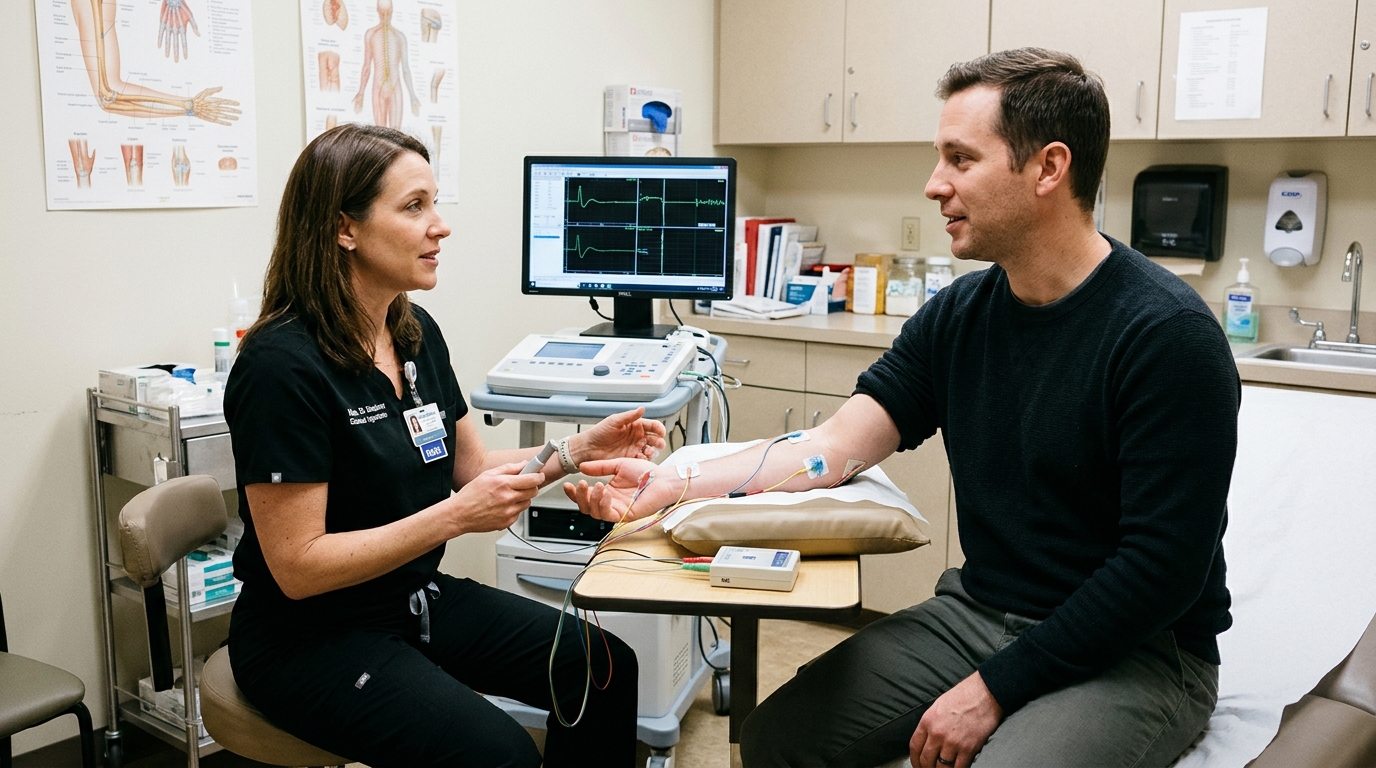
It starts with a conversation. Which fingers go numb, when it happens, whether you’re dropping things, whether you ever broke that elbow. Small details like “it’s worse after I drive to work” actually help a lot.
The physical exam follows. Your doctor may tap lightly over the nerve at the elbow, like the tap tests in a carpal tunnel self-test, but in a different spot. You might be asked to hold your elbow fully bent for a minute to see whether the tingling shows up. Then come strength checks: spreading the fingers apart, pinching a sheet of paper between thumb and index finger, gripping.
The most useful test for cubital tunnel syndrome is a nerve conduction study with electromyography (NCS/EMG). The nerve study sends small electrical pulses along the nerve and measures how fast the signal travels. If it slows down right across the elbow, that’s strong evidence the problem lives there and not in the wrist or neck. EMG uses a thin needle to check how the muscles respond, showing whether nerve damage has started affecting them.
At Lone Star Neurology, we do NCS/EMG right in the office, and the study usually takes about 30 to 45 minutes. The pulses feel like quick snaps, uncomfortable but brief. One practical tip: skip lotion on your arms that day, since it interferes with the electrodes. Several of our neurologists completed fellowship training in neuromuscular medicine or clinical neurophysiology, the field that reads these studies.
Imaging fills in the rest when it’s needed. Ultrasound can show a swollen or shifting nerve. X-rays look for old fractures or arthritis. MRI is saved for unclear cases, and for working patients it helps that our MRI is open on Saturdays.
Treatment Without Surgery
Most mild to moderate cases start with one goal: take the pressure off the nerve and give it time. Conservative cubital tunnel syndrome treatment is mostly about changing positions you repeat thousands of times without thinking.
At night, the aim is to keep the elbow straighter. Some people wrap a towel loosely around the elbow so it can’t fully bend. Others use a cubital tunnel brace, a padded night splint made for this. It feels odd for the first few nights. Most people get used to it.
During the day, small fixes add up. A headset or speakerphone for long calls. A soft pad on the desk edge. Keeping the elbow off the car window ledge on that I-35 commute. None of this is exciting, and that’s sort of the point.
Doctors and therapists may also suggest cubital tunnel syndrome exercises, usually called nerve gliding. These are slow, gentle movements meant to help the nerve slide through the tunnel instead of getting stuck. The evidence is mixed. A Cochrane review of randomized trials found very few studies on nonsurgical care, so nobody can promise these moves will fix the problem. Still, many patients find them helpful. Proper cubital tunnel syndrome exercises should never worsen tingling or weakness, and hard stretching can further irritate the nerve. It’s best to learn cubital tunnel syndrome exercises from a therapist or your doctor and not from a random video.
Anti-inflammatory pain relievers can ease the ache for a short time, but they don’t remove the pressure on the nerve. They can also cause side effects, including stomach irritation, kidney strain, and higher blood pressure, so they aren’t right for everyone. Steroid injections, which help with many other joint problems, generally aren’t used here because they can damage the nerve.
When Surgery Is Considered, and When to Come In
Surgery comes up when conservative care hasn’t helped, when testing shows significant nerve damage, or when weakness and muscle wasting are already there. Like any operation, cubital tunnel surgery carries risks: infection, a tender scar, elbow stiffness, and numbness that improves slowly or not completely. Muscle that has been wasted for a long time may not fully return. That’s why doctors watch these cases closely and don’t wait too long.
The most common procedure is a cubital tunnel release, where the surgeon divides the tissue roof of the tunnel to give the nerve more room. Sometimes the nerve is also moved to the front of the elbow (transposition), especially if it keeps slipping over the bone. The Cochrane review mentioned above found that simple decompression and transposition led to similar functional improvement. The choice depends on your anatomy and what the surgeon sees.
So when should you get checked? A reasonable rule: if cubital tunnel syndrome symptoms show up most days for a few weeks, wake you at night, or come with clumsiness, it’s time to get checked. Dropping things or a visible dip in the hand muscles means sooner. Sudden weakness in one arm, along with a drooping face or slurred speech, is a different situation entirely. That’s a possible stroke, and you should call 911.
Ulnar nerve entrapment is common, and caught early, it often settles with simple changes. Lone Star Neurology has 22 locations across DFW, Austin, Houston, and San Antonio, and the full workup from exam to NCS/EMG can usually be done in one place. Getting the right cubital tunnel syndrome treatment starts with knowing exactly where the nerve is pinched. To schedule a visit, call 214-619-1910.







Please, leave your review
Write a comment: