

Lewy body dementia is a progressive brain disease caused by clumps of alpha-synuclein. This protein builds up inside nerve cells and disrupts thinking, movement, sleep, and alertness from hour to hour. In many patients, it first shows itself through vivid hallucinations, physically acting out dreams, or an odd back-and-forth between clear days and foggy ones, rather than through the forgetfulness people associate with Alzheimer’s. Telling the two apart early matters for a very practical reason: a few drugs routinely used for confusion can cause severe reactions in someone with Lewy bodies.
A familiar story: a woman brings in her father because he asked her, quite calmly, who the kids in the living room were. Nobody was there. By morning he’d forgotten it entirely. She assumed early Alzheimer’s (most families do), and she was wrong.
What Lewy Body Dementia Actually Is
So what is Lewy body dementia, exactly? The term covers two closely related diagnoses, dementia with Lewy bodies and Parkinson’s disease dementia, both driven by the same protein deposits, called Lewy bodies.
Normally, alpha-synuclein helps neurons pass signals to one another. Once it misfolds and starts to clump, the damage spreads through the cortex and brainstem, and levels of two chemical messengers drop: acetylcholine, which the brain needs for attention, and dopamine, which keeps movement smooth.
It isn’t rare. About 1 million Americans are living with it, and roughly one person in five with dementia turns out to have dementia with Lewy bodies (DLB). Even so, up to 70% of patients are first misdiagnosed, usually with Alzheimer’s. Symptoms usually start after 50, though age alone doesn’t prove anything.
Timing separates the two forms. If thinking problems come first, or show up within a year of the movement symptoms, doctors call it DLB; if someone has had Parkinson’s for at least a year before dementia appears, it’s Parkinson’s disease dementia.
Early on, memory often holds up better than attention and visual-spatial skill. People misjudge the distance to a chair or take a wrong turn on a route they’ve driven for twenty years.
The Four Core Symptoms Families Notice First
The Lewy body dementia symptoms that carry the most weight in a diagnosis are the four core clinical features defined by the DLB Consortium. Dementia plus any two of them is enough for a “probable” diagnosis, though plenty of patients never develop all four, and the mix tends to shift over time.
- Attention. It can swing wildly in a single afternoon. Families describe staring spells, long naps, muddled speech, then a stretch where the person is entirely themselves again.
- Hallucinations. Usually people, children, or animals, and surprisingly detailed. Arguing rarely helps; something like “I don’t see him, but I’m here with you” tends to go over better.
- Sleep. REM sleep behavior disorder, meaning talking, yelling, punching, or kicking while dreaming.
- Movement. Slowness, stiffness, small shuffling steps, poor balance. The tremor is generally milder than in Parkinson’s, but falls aren’t.
Other clues: lightheadedness on standing (orthostatic hypotension), constipation, a fading sense of smell, low mood.
If there’s one habit we’d ask families to drop, it’s reading a good day as proof that everything’s fine. With this disease, the good days are part of the pattern, so jot down the bad ones too.
Acting Out Dreams Can Start Years Before the Memory Changes
Sometimes the very first sign of Lewy body dementia turns up at night, ten years or more before anyone notices trouble with thinking. In a multicenter study that followed people with isolated REM sleep behavior disorder, about 74% developed Parkinson’s disease, DLB, or a related condition within 12 years. The flip side is worth saying out loud: about a quarter of them didn’t.
In healthy REM sleep, the big muscles are switched off, so you can dream about running without running. When that switch fails, the dream gets acted out. It’s almost always the bed partner who notices first (shouting, flailing arms, kicks aimed at some invisible attacker, now and then a fall out of bed).
Meanwhile, make the bedroom safer. Shift the nightstand and anything sharp away from the bed, lower the mattress or pad the floor, and get firearms out of the room.
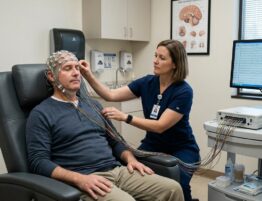
The test that settles it is polysomnography, the overnight study standard for diagnosing sleep disorders. It shows whether muscles stay active during REM sleep and rules out sleep apnea, a common mimic. Our sleep disorder center can set it up.
How It Differs From Alzheimer’s and Parkinson’s

Alzheimer’s typically begins with new memories that won’t stick. Lewy body dementia more often begins with attention, vision-based problems, alertness, and sleep, while Parkinson’s starts with movement and may only touch thinking years down the line.
| Feature | Dementia with Lewy bodies | Alzheimer’s disease | Parkinson’s disease dementia |
| :—: | :—: | :—: | :—: |
| Earliest problem | Attention, visual-spatial skills | Forming new memories | Tremor, stiffness, slowness |
| Memory early on | Often fairly preserved | Affected early | Usually affected later |
| Visual hallucinations | Early, detailed, common | Usually late, if at all | Possible, often later |
| Day-to-day swings | Marked | Mild | Can occur |
| Acting out dreams | Common, may come years earlier | Uncommon | Common |
Real patients don’t always fit the columns: plenty of people with Lewy bodies also carry Alzheimer’s-type changes in the brain, which is part of why the difference between dementia and Alzheimer’s confuses so many families, and why no single symptom ever makes the call.
And is Lewy body dementia hereditary? Only rarely. Most cases are sporadic. A handful of families carry mutations in the SNCA gene, and variants in GBA or APOE ε4 raise risk without determining it. If several close relatives had dementia or Parkinson’s, or symptoms started unusually early, mention it to your neurologist anyway.
How the Disease Progresses and the Medication Warning Every Family Needs
Nobody’s course looks quite like anyone else’s. Doctors generally talk about three broad Lewy body dementia stages, and the average course runs 5 to 8 years after diagnosis, though some people live 2 years and others 20.
- Early: attention that comes and goes, trouble with spatial tasks, hallucinations, acting out dreams, slight slowness. Daily life still mostly works, with some help.
- Middle: more confusion, stiffer muscles, falls, dizzy spells from blood pressure drops. Household tasks need a second pair of hands.
- Late: severe cognitive loss, very little speech, inability to walk, trouble swallowing, round-the-clock care.
Across all Lewy body dementia stages, the fluctuations muddy things. A rough week can look like a jump to the next stage, and then the person bounces back, which is why we judge progression over months, not days.
The 7 stages of Lewy body dementia you’ll see online are borrowed from the Global Deterioration Scale, a tool designed for Alzheimer’s. Treat it as a loose sketch.
Lewy body dementia treatment is about symptoms and safety, because so far nothing slows the underlying disease. Cholinesterase inhibitors (donepezil, rivastigmine) often sharpen attention and calm hallucinations. Carbidopa-levodopa can loosen stiffness, but push the dose too high and hallucinations tend to get worse. For dream enactment, melatonin is usually the first thing we try. Therapy cuts down on falls and choking, and most of what works when caring for a parent with dementia at home works here too.
Now for the part every family should hear. Up to half of people with Lewy body dementia react badly to antipsychotics, with sudden rigidity, heavy sedation, deeper confusion and falls, and occasionally neuroleptic malignant syndrome, which can be fatal. Haloperidol, often given for agitation in ERs, is the worst offender. “PM” sleep aids with diphenhydramine can worsen confusion too.
What looks like a Lewy body dementia fast decline is, surprisingly often, one of these drug reactions or delirium from an infection, and both can be partly or fully reversed if someone catches them early. Tell every doctor and ER about the diagnosis, carry a medical alert card from the Lewy Body Dementia Association, and never stop a prescription on your own.
When to Bring This to a Neurologist in Dallas-Fort Worth
Families do ask it, usually quietly: how does Lewy body dementia kill you? In most cases, it’s the complications, not the disease directly. Weak swallowing leads to aspiration pneumonia, infections go unnoticed, a fall ends in a head injury or broken hip, or long weeks in bed take their toll.
Call 911 or head to the emergency room if someone with known or suspected Lewy body disease has:
- confusion that comes on suddenly, over hours or a few days
- severe stiffness and fever after starting a new medication
- a fall with a blow to the head
- choking during meals, then fever or trouble breathing
- one-sided weakness, a drooping face or slurred speech
Book a neurology appointment soon if you’re seeing these symptoms of Lewy body dementia:
- hallucinations of people or animals that keep coming back
- shouting, hitting, or falling out of bed while asleep
- falls nobody can explain, or a new shuffle
- big swings in alertness from one day to the next
- dizziness or fainting when standing
Lone Star Neurology sees patients throughout Dallas-Fort Worth, Allen, Plano, and Frisco, among others, as well as Austin, Houston, and San Antonio. Our memory clinic handles exactly these concerns. Call 214-619-1910 or book an appointment online.
Before that first visit, jot down the symptoms of Lewy body dementia you’ve noticed, with rough dates. A phone video of a night episode helps; half a minute of footage often tells us more than a page of notes. Bring all medications, and ideally someone who has seen the episodes.
The neurologist will go through the history, run cognitive and neurological exams, and weigh the Lewy body dementia symptoms against other possible causes. Next steps might include an MRI, a sleep study, or a DaTscan, which the FDA approved for suspected DLB in 2022. Then comes a Lewy body dementia treatment plan built with you.
If you landed here searching for what Lewy body dementia is because something about a parent’s behavior just doesn’t add up, take that feeling seriously. An early, accurate diagnosis keeps the wrong medications away.
This article is for general education and doesn’t replace a consultation with a doctor. Don’t start, stop, or change any medication without talking to the clinician who prescribed it.
 (No Ratings Yet)
 Loading...







I've given up... the stress her office staff has put me through is just not worth it. You can do so much better, please clean house, either change out your office staff, or find a way for them to be more efficient please. You have to do something. This is not how you want to run your practice. It leaves a very bad impression on your business.
Please, leave your review
Write a comment: