

It usually starts small, for example, when you finish a long phone call and notice your pinky finger numb, along with the outer half of the ring finger. Or you wake at night with fingers buzzing. By morning the inside of your elbow aches a little, as if you bumped your funny bone and the feeling never fully left.
Someone notices their pinky and ring finger numb, decides it must be carpal tunnel, buys a wrist brace and wears it faithfully for three months. Nothing changes, because the problem sits about a foot higher, at the elbow.
That specific map of numbness points to one nerve and one condition: cubital tunnel syndrome. Below, we cover the cause, the tests, and the treatments, with real evidence behind them.
What Is Cubital Tunnel Syndrome?
In plain terms, what is cubital tunnel syndrome? It is pressure on the ulnar nerve where it passes the elbow.
The ulnar nerve starts in the neck and runs down the arm into the hand. At the elbow, it squeezes through a narrow passage behind the bony bump on the inner side of the joint. That passage is the cubital tunnel, and the spot where the nerve runs is what people call the funny bone. With almost no padding there, a light knock sends a jolt into your little finger.
Think of the nerve as a garden hose wrapped around a corner. Each time you bend your elbow, the hose gets pulled tighter around that corner and the tunnel gets smaller. The American Academy of Orthopaedic Surgeons (AAOS) explains that bending the elbow both stretches the nerve and reduces its blood supply, which is why symptoms flare with the arm flexed.
A few minutes of this does no harm. Hours of it, night after night, start to wear down the nerve’s insulation and eventually the nerve fibers themselves. This chronic ulnar nerve compression is what turns an occasional tingle into a medical problem.
The numbness follows a precise map because the ulnar nerve supplies feeling to only two areas: the little finger and the half of the ring finger closest to it.
Symptoms and How They Progress
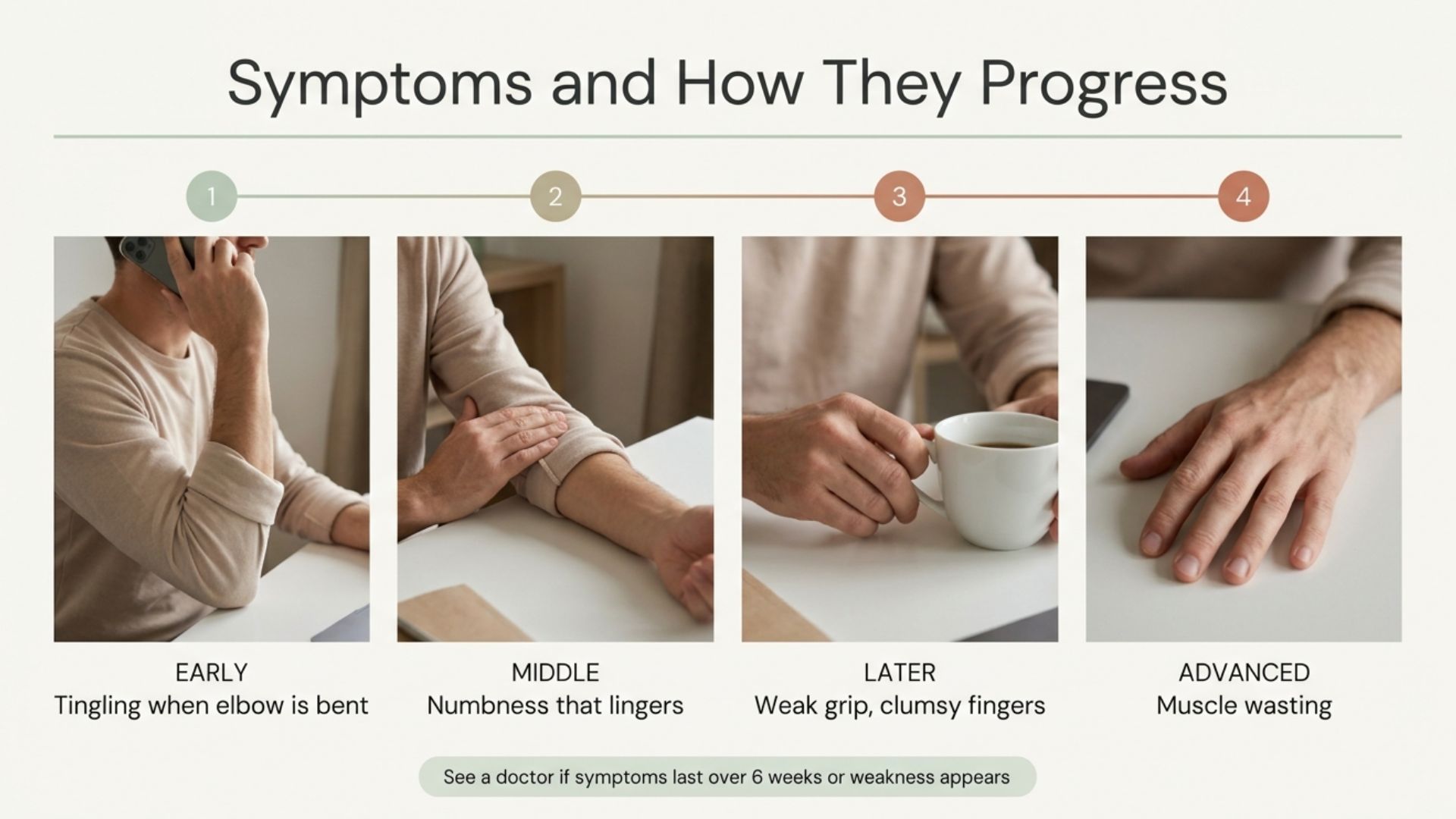
Cubital tunnel syndrome symptoms tend to build in stages:
- Early: tingling that comes and goes with elbow position, worse when driving, holding a phone, or sleeping with the arms bent.
- Middle: numbness that lingers after you straighten the arm, plus ulnar nerve pain felt as an ache along the inner elbow.
- Later: a weaker grip and pinch, clumsy typing, trouble spreading the fingers apart, dropping keys or cups.
- Advanced: visible hollowing of the muscle between the thumb and index finger.
That last stage matters most. According to AAOS, muscle wasting caused by long-term compression cannot be reversed, and they advise seeing a doctor when symptoms are severe or when milder symptoms have lasted more than six weeks. If the numbness doesn’t go away when you change position, or you notice any weakness, it is worth booking an evaluation soon.
Cubital Tunnel vs Carpal Tunnel
A quick self-check is to look at which fingers feel numb.
- Carpal tunnel: thumb, index, middle, and the thumb side of the ring finger. The median nerve is pinched at the wrist.
- Cubital tunnel: little finger and the pinky side of the ring finger. The ulnar nerve is pinched at the elbow.
The ring finger is the giveaway, since its two halves belong to two different nerves. Position also helps. Carpal tunnel symptoms tend to flare with a bent wrist, like gripping a steering wheel or a mouse. Ulnar nerve entrapment at the elbow flares with a bent elbow.
Some people have both at once, which may explain why a wrist brace helps part of the hand while leaving the pinky untouched. You can compare the classic signs of carpal tunnel syndrome side by side with what you are feeling, though only testing can say for sure.
Causes and Diagnosis
In many people with cubital tunnel syndrome, no single event explains the problem. Common contributors to ulnar nerve entrapment include:
- sleeping with the elbows tightly bent
- leaning on the elbow at a desk, on an armrest or on a car window ledge
- jobs or hobbies with constant elbow bending, including throwing sports
- an old elbow fracture, bone spurs or arthritis
- a nerve that slips out of its groove and snaps back over the bone with each bend
- a ganglion cyst or swelling near the joint
- conditions that make nerves more vulnerable, such as diabetes and thyroid disease
The evaluation starts with an exam. Your doctor may tap over the nerve to see whether it sends a zing into the fingers, hold your elbow bent to see whether symptoms appear, test grip and pinch strength, and check whether the nerve slides out of place.
EMG with nerve conduction studies settles the question. Small electrical pulses measure how fast signals travel along the nerve. If they slow down right across the elbow, the compression has been found. A thin needle then checks the hand muscles for signs of damage, which grades severity.
Why does this matter? A pinched nerve root in the neck can cause almost the same numbness in the same fingers. Without testing, it is easy to treat the elbow when the real issue is in the spine, or vice versa.
Treatment Options
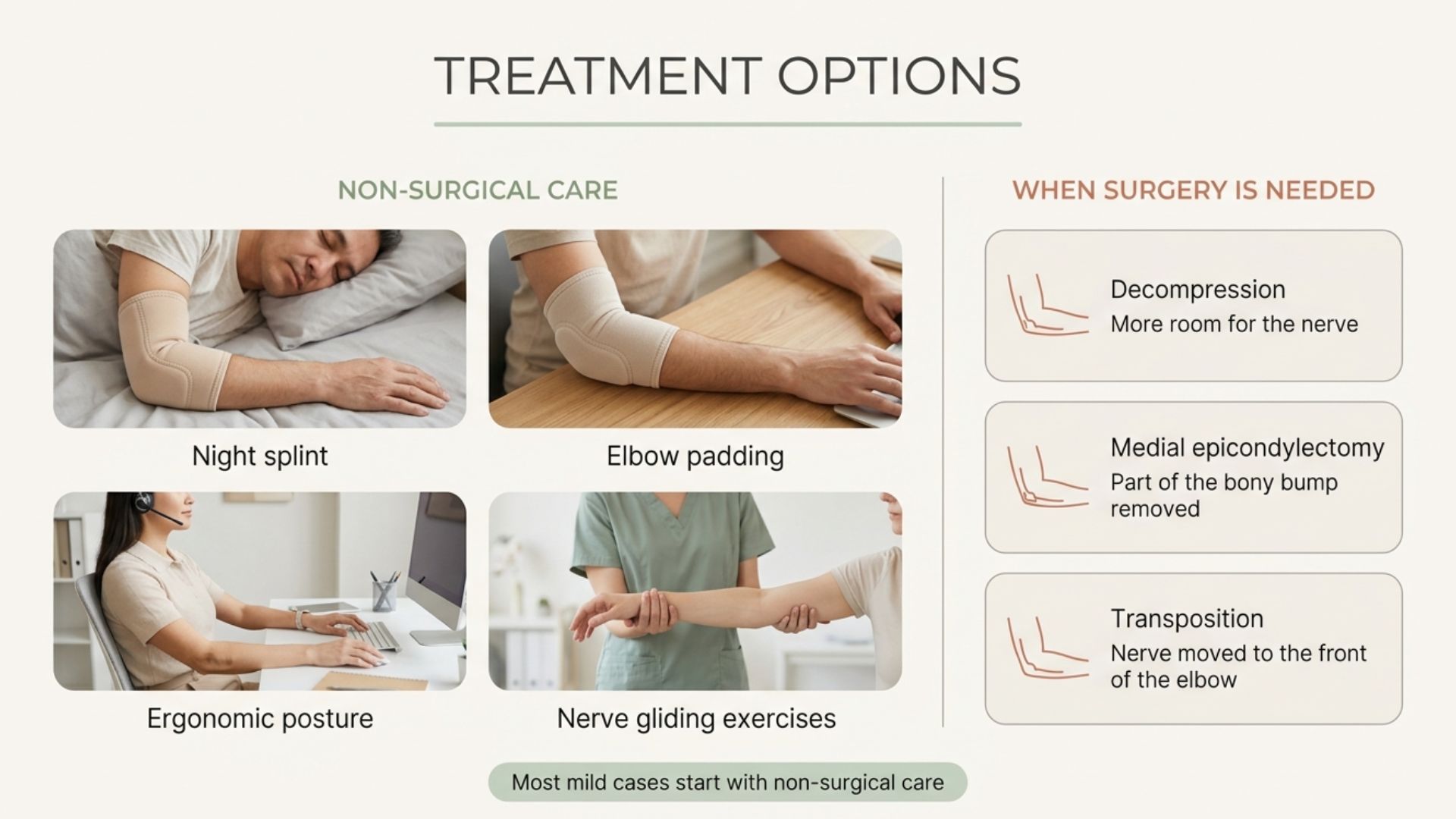
For mild and moderate cases, cubital tunnel syndrome treatment usually starts without surgery. AAOS notes that most people can manage symptoms with activity changes and bracing. Options include:
- a night splint, or a towel loosely wrapped around a straight elbow, to stop the arm from bending during sleep
- elbow padding and avoiding leaning on the inner elbow
- a higher chair, a headset or speakerphone for long calls, and no elbow resting on armrests
- nerve gliding exercises taught by a clinician or therapist
- a short course of anti-inflammatory medicine for new symptoms, which carries its own risks for the stomach and kidneys and is a decision for your doctor
Steroid injections are generally avoided for ulnar nerve compression at the elbow because they can harm the nerve.
A 2025 Cochrane review of 15 randomized trials found that in mild cases, simply learning which positions and movements to avoid may reduce discomfort. Evidence for splints and gliding exercises comes from small single trials. Doctors typically reassess after a few months to decide whether conservative care is working.
When numbness is constant, weakness appears, or testing shows significant damage, surgery becomes the main conversation. Options include:
- Decompression: releasing the tissue roof of the cubital tunnel so the nerve has more room.
- Medial epicondylectomy: removing part of the bony bump.
- Transposition: moving the nerve to the front of the elbow.
The same Cochrane review found little to no difference in functional improvement between simple decompression and transposition. Most procedures are outpatient. Recovery can mean a splint for days to several weeks. Nerves heal slowly, so tingling may take months to settle, and after years of compression, some numbness or weakness may remain.
Get Your Nerves Tested in Texas
The quickest route to effective cubital tunnel syndrome treatment is knowing exactly which nerve is involved and how badly. Confirming cubital tunnel syndrome and grading it is a neurologist’s job. Starting here can save months of wearing the wrong brace and can prevent surgery that was never needed, since many mild cases respond to simple changes.
At Lone Star Neurology, we perform nerve conduction studies and EMG in the physician’s office, and they usually take 30 to 45 minutes. Our team includes neurologists board-certified in clinical neurophysiology, the specialty built around these tests, and physicians with fellowship training in neuromuscular medicine. A small practical tip: skip lotion on your arms the day of the test, since it interferes with the electrodes.
If your doctor suspects neck involvement, a cervical spine MRI can help, and we are open on Saturdays for MRI.
Please don’t wait if you have constant numbness, weakness in your grip, or any hollowing in the hand muscles. Ulnar nerve pain and numbness are far easier to treat before the muscles start to shrink.
We see patients at 22 locations across Texas, including Dallas, Plano, Frisco, McKinney, Fort Worth, Arlington, Grapevine, Denton, Austin, Houston, and San Antonio. Call 214-619-1910, or book online.
Medical disclaimer: This article is for general information only and does not replace a visit to a doctor. Please do not self-diagnose or self-treat. If you have numbness, weakness, or pain in your hand, see a qualified physician.
 (No Ratings Yet)
 Loading...







I've given up... the stress her office staff has put me through is just not worth it. You can do so much better, please clean house, either change out your office staff, or find a way for them to be more efficient please. You have to do something. This is not how you want to run your practice. It leaves a very bad impression on your business.
Please, leave your review
Write a comment: