

You’re crossing the living room in socks, and your toes snag the rug. Again. Or your right foot slaps the sidewalk with a sound you never used to make. Some people start lifting that knee a little higher, like stepping over a puddle that isn’t there.
Those are classic signs of foot drop, and families ask us about them all the time. Most often, the culprit is the peroneal nerve where it wraps around the outside of the knee. The L5 nerve root in the lower back can cause the very same picture, and so can problems higher up in the spinal cord or brain. Finding the exact spot is the whole game.
This article is for general education and isn’t a substitute for an exam. If your foot has started to catch or slap the ground, please see a doctor instead of trying to sort it out at home.
What Foot Drop Is
Foot drop is a weakness in the muscles along the front of the shin that lift the foot and toes. During a normal step, those muscles lift your toes as the leg swings forward so they clear the floor. When they weaken, the front of the foot sags. The National Institute of Neurological Disorders and Stroke describes the condition as trouble lifting the front of the foot, often with dragging toes, a high-knee “steppage” gait, and a higher risk of falls.
That high knee is a clever workaround. It gets the foot over the floor, then the foot comes down fast and slaps. The workaround works, but it tires the hip and thigh, and it doesn’t fix anything underneath. Some doctors call it drop foot; others call it foot drop.
The weakness can hit one leg or both. One side usually points toward a local squeeze on a nerve or nerve root, while both sides push a doctor to look at the wider nervous system. Drop foot can creep in over weeks, or it can show up overnight after a fall or surgery. Doctors treat it as a symptom of something else, which is why the workup matters more than the label.
Early Signs Before the Obvious Limp
A visible limp is late in the story. The early signs of foot drop are small, and people usually explain them away:
- One shoe wears out faster than the other, with a scuffed toe or outer edge.
- You trip on a rug or a doorway threshold that looked perfectly flat.
- Walking a few steps on your heels is hard, because the toes on the weak side flop down (stay near a wall or counter if you try this).
- Stairs feel off, as if the ankle gives way or the foot won’t clear the step.
- You hear your foot slap before you feel it.
- A patch of tingling or numbness shows up on the top of the foot or outer shin, and the causes of numbness in the hands and feet overlap with what we look for here.
Foot drop often goes unnoticed by the person living with it, because the brain adapts fast. A spouse who watches you walk away from the car often spots it first. Any of these early signs of foot drop that keep repeating for more than a couple of weeks deserve a visit. Two situations skip the waiting room entirely. Sudden leg weakness with a drooping face, slurred speech, or a weak arm needs 911. So does leg weakness with back pain, numbness in the groin or inner thighs, or new bladder or bowel trouble.
Where the Problem Can Be
Picture the pathway from brain to ankle as one long cable. A break anywhere along it can leave the same limp foot. Each level leaves its own fingerprints:
- The peroneal (fibular) nerve sits close to the skin at the outer knee. Peroneal nerve injury weakens the foot lift and often numbs the top of the foot and outer lower leg.
- The L5 root leaves the spine in the low back. When a disc pinches it, a condition spine doctors call radiculopathy or radiculitis, the big toe often goes weak too, and back, buttock, or leg pain usually comes along.
- The sciatic nerve is the thick parent of the peroneal nerve. Damage here can weaken more muscles and numb a wider area.
- When many nerves are involved at once, as in polyneuropathy, it can weaken both feet and cause burning or tingling.
- The spinal cord or brain adds clues like stiffness, brisk reflexes, and clumsy coordination.
This is why what causes a drop foot in your case can’t be guessed from the limp alone. Level first, cause second. The foot drop causes differ at each level, and so do the odds of getting strength back.
The Common Causes
Foot drop causes range from a temporary nerve pinch to disease of the brain or spine. The story around the onset helps a lot. A recent surgery, a hospital stay, a long flight with crossed legs, or a spell of heavy gardening can all show up in the notes. Here’s what we see most:
- Rapid weight loss thins the fat pad that cushions the nerve at the knee, so even a hard chair edge can press on it.
- A knee fracture, dislocation, surgery, or tight cast can directly injure the nerve.
- Habits count too: crossing the legs for hours, or long stretches of squatting and kneeling.
- A herniated disc in the lumbar spine can press on the L5 root.
- Long-standing high blood sugar harms nerves, and diabetic neuropathy usually weakens or numbs both feet.
- Stroke, multiple sclerosis, ALS, cerebral palsy, Charcot-Marie-Tooth disease, and muscular dystrophy are less common foot drop causes that work through the brain, spinal cord, nerves, or muscles.
Notice how many of these are fixable. That’s the quiet good news in this symptom.
How It Is Diagnosed
A neurologist starts with your story: when it began, any surgery or weight change, back pain, diabetes, how often you’ve fallen. Then the hands-on exam begins:
- Strength testing of the ankle lift, big toe, and sideways ankle movement. Turning the ankle inward is usually spared when the trouble sits at the knee and weak when it’s the L5 root, a small quirk that points to the site.
- A map of feeling over the foot and shin
- Reflex checks with the tendon hammer
- A close look at how you walk, where the foot lands, how high the knee goes
Tests then confirm the guess. Nerve conduction studies and EMG show where a signal slows down or stops. We can arrange nerve conduction and EMG testing, which usually takes about 30 to 45 minutes. Our locations are open Saturdays for MRI, so a scan of the lumbar spine or knee doesn’t have to cost a workday. Call 214-619-1910, and we’ll point you to the closest of our 22 locations.
Getting the level right matters, because foot drop treatment for a pinched root looks nothing like treatment for a compressed nerve at the knee.
Treatment, Braces and What Recovery Looks Like
Foot drop treatment follows the cause. When the nerve is squeezed at the knee, the first step is removing the pressure: no leg crossing, no long squatting, and knee padding. A disc problem may call for physical therapy or a spine specialist’s plan. Diabetes means tighter blood sugar control with your doctor. The options below can run side by side:
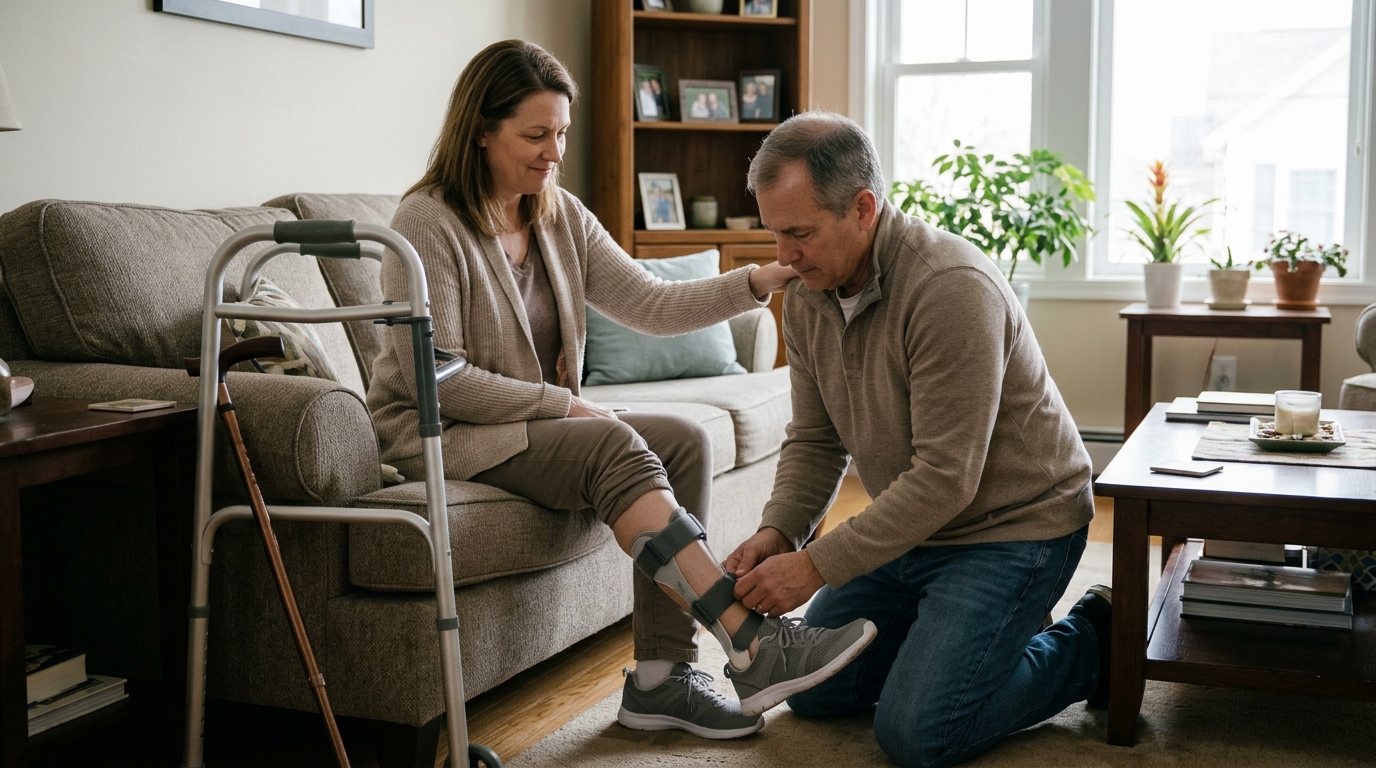
- A foot drop brace, usually a light plastic ankle-foot orthosis, holds the toes up during the swing phase. Clinicians choose a drop foot brace by considering muscle strength, ankle stiffness, your shoes, and your day. An AFO brace for foot drop can be rigid or flexible. Trade-offs include skin irritation, pressure spots, and a bulkier fit in your shoe.
- Physical therapy keeps the ankle from stiffening, strengthens the muscles that still work, and trains balance.
- Functional electrical stimulation fires the nerve at the right moment in each step. It doesn’t suit everyone; skin irritation can happen, and anyone with an implanted device should talk to a doctor first.
- Surgery may release or repair a compressed nerve. When the loss is permanent, surgeons can transfer a tendon or fuse the ankle. Risks include infection, bleeding, and new numbness, and results vary. In the weight loss review, the authors suggested considering decompression if nothing improves after about three months.
Recovery depends heavily on the cause. NINDS notes that foot drop from injury or nerve damage often improves partly or fully, while foot drop from a progressive brain disease is usually permanent and can worsen.
Nobody can promise a timeline from a single visit, and a good clinician will say so. Living with foot drop during recovery also means planning for safety: clear the loose rugs, put night lights along the hallway to the bathroom, and wear shoes with a firm sole indoors.
If your toes keep catching, don’t wait for the limp. Call 214-619-1910 or book online.








Please, leave your review
Write a comment: