

Almost everyone has experienced that dull, aching pressure across the forehead or around the back of the head after a long, demanding day. When asked what a tension headache is, the simplest definition is that it is the most common form of primary headache, affecting millions of adults across the United States.
Unlike migraines or cluster headaches, tension-type headaches rarely cause throbbing pain or severe nausea. Instead, they present as a steady, pressing discomfort that can make focusing on work or family life feel exhausting. Despite how frequently they occur, many people push through the pain without realizing how manageable the condition can actually be.
Recognizing early tension headache symptoms is the first step toward reclaiming your daily comfort and productivity. Whether your episodes happen occasionally or have begun to creep into your routine, safe and effective options exist to ease the tightness and prevent future occurrences.
At Lone Star Neurology, our team provides expert, compassionate care to help patients across Texas find lasting relief from chronic head pain. With 17+ locations throughout the Dallas-Fort Worth metroplex, Austin, Houston, and San Antonio, our board-certified specialists focus on personalized solutions that get to the root of your symptoms.
Common Tension Headache Symptoms You Shouldn’t Ignore
To effectively address head discomfort, you need to know what signs to look for. Recognizing key tension headache symptoms helps differentiate them from other neurological conditions, ensuring you choose the right approach for relief.
The classic hallmark of a tension-type headache is a mild-to-moderate, constant ache felt on both sides of the head. Patients often describe the feeling as a tight band or vise wrapped tightly around their forehead, temples, or the base of the skull. The pain is typically dull and aching rather than sharp or pulsating.
Common physical signs and sensations include:
- A sensation of tightness or pressing discomfort across the forehead, temples, or back of the head.
- Tenderness in the scalp, neck muscles, and shoulder girdle when touched.
- Mild sensitivity to light or sound, though rarely both at the same time.
- Muscle stiffness that radiates upward from the upper back into the neck and head.
It is also very common to experience a neck tension headache, where intense tightness in the cervical muscles spreads upward to create a continuous, distracting ache. Paying attention to these physical cues allows you to take action early before the pain becomes more severe.
What Triggers a Tension Headache?
Understanding what a tension headache is involves looking at the physical and environmental factors that spark muscle contractions in the head and neck. While the underlying neurological mechanism involves altered pain processing in central nerve pathways, physical strain and mental stress remain primary triggers.
Mental and emotional stress is overwhelmingly the most common trigger. When you feel anxious, hurried, or overwhelmed, muscles throughout your shoulders, neck, and jaw involuntarily tighten. Over hours, this persistent muscle contraction leads directly to pain signals traveling to the brain.
Physical habits play a major role as well. Poor posture while working at a computer, hunching over a smartphone, or slouching in an uncomfortable chair puts enormous strain on cervical muscles, frequently causing a neck tension headache. Additional common triggers include:
- Prolonged eye strain from uncorrected vision or hours of screen time.
- Dehydration and missed or delayed meals throughout the day.
- Fatigue, lack of restful sleep, or irregular sleep schedules.
- Clenching your jaw or grinding your teeth during sleep or periods of intense concentration.
Tension Headache vs. Migraine: Key Differences
Because both conditions involve significant head pain, patients frequently confuse them. However, examining tension headache vs migraine characteristics reveals critical differences in pain intensity, location, and accompanying physical symptoms.
Tension-type headaches usually cause a dull, steady ache on both sides of the head (bilateral). The pain is mild to moderate and generally does not prevent you from performing daily tasks, even if it feels uncomfortable. Crucially, routine physical activity like walking or climbing stairs does not make a tension headache worse.
In contrast, migraines typically cause severe, throbbing, or pulsating pain that is often concentrated on one side of the head (unilateral). Migraines are frequently accompanied by nausea, vomiting, extreme sensitivity to light and sound, and visual disturbances known as auras.
When evaluating tension headache vs migraine patterns, key distinctions include:
- Pain Type: Tension headaches produce a steady, band-like tightness, whereas migraines create a throbbing or pulsating sensation.
- Location: Tension headaches affect both sides of the head, while migraines typically affect one side.
- Impact of Movement: Physical exertion does not worsen tension headaches, but it significantly aggravates migraine pain.
- Associated Symptoms: Nausea and extreme light sensitivity accompany migraines, but are absent in typical tension headaches.
Proven Tension Headache Relief You Can Try at Home
When a mild to moderate episode strikes, several non-pharmacological, drug-free strategies can reduce muscle tightness and calm your nervous system. Developing a reliable self-care toolkit allows you to respond quickly at the first sign of discomfort.
Targeting specific acupressure points can provide rapid physical ease. Applying firm, steady pressure to tension headache relief pressure points, such as the LI4 (Hegu) point located in the webbing between your thumb and index finger, or points at the base of your skull, helps release built-up muscular tension.
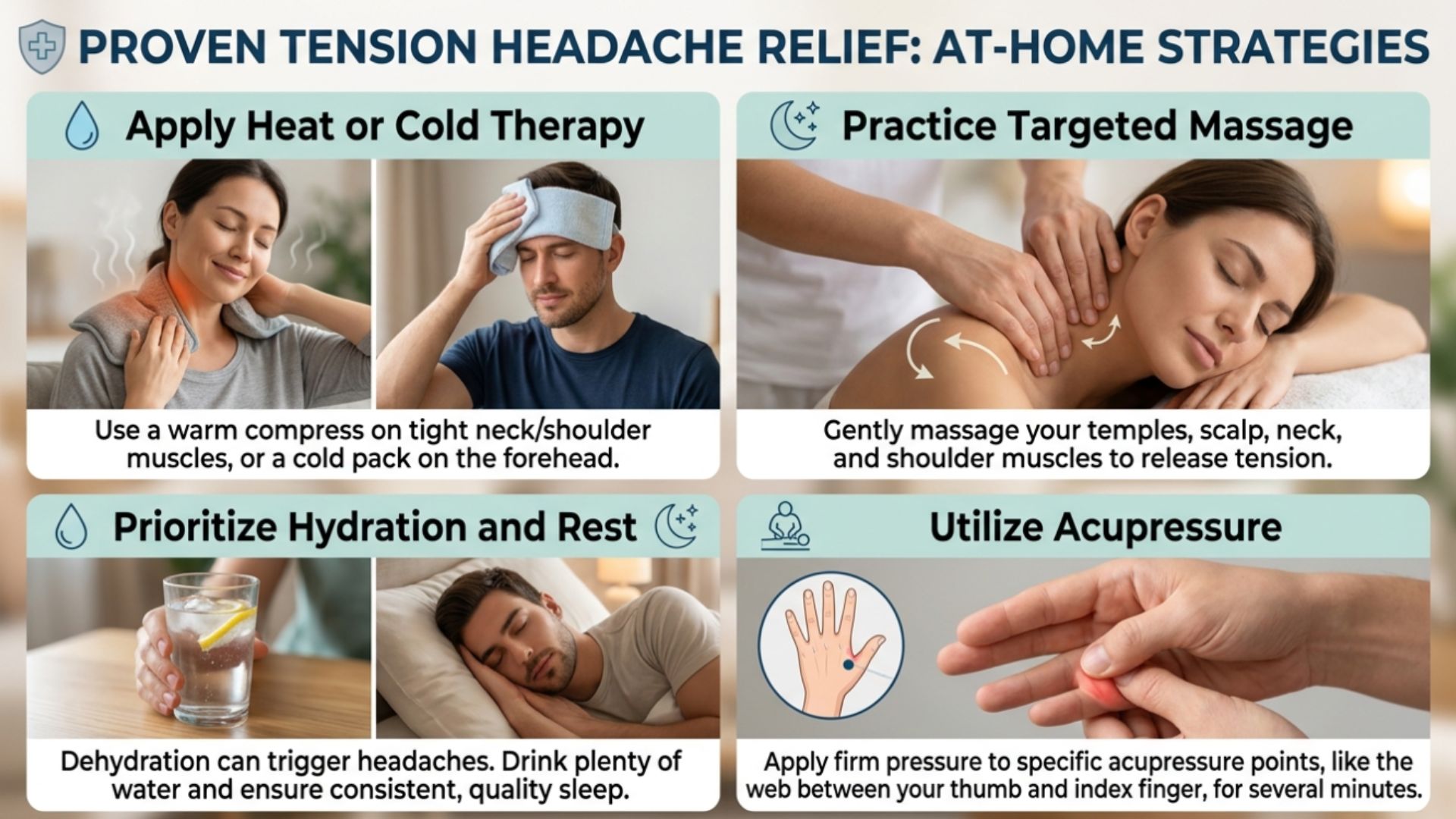
Incorporate these evidence-based self-care steps for immediate physical comfort:
- Apply Heat or Cold Therapy: Place a warm heating pad or warm towel around your neck and shoulders to relax tight muscles. Alternatively, an ice pack applied to the forehead can numb dull aching sensations.
- Practice Targeted Massage: Gentle, circular finger pressure applied during a targeted tension headache massage along the temples, jawline, and base of the neck helps increase local blood circulation and release physical knotting.
- Prioritize Hydration and Rest: Drink a large glass of water immediately, step away from bright screens, and sit in a quiet, dimly lit room for 15 minutes while taking slow, deep breaths.
- Utilize Acupressure: Applying pressure to tension headache relief pressure points for 1 to 2 minutes helps send relaxing signals to tense muscle groups.
Establishing consistent tension headache self-care habits – such as taking regular stretch breaks during the workday, practicing gentle neck movements, and maintaining a regular sleep schedule – can drastically reduce how often these episodes occur.
Medications and Treatments That Actually Work
For episodes that do not respond fully to conservative home measures, various medical options exist. Depending on whether your headaches are occasional (episodic) or occur more than 15 days a month (chronic), your doctor can recommend targeted therapies.
Over-the-counter (OTC) pain relievers are usually the first line of defense. Selecting an appropriate tension headache medication, such as acetaminophen or nonsteroidal anti-inflammatory drugs (NSAIDs) like ibuprofen or naproxen, can effectively disrupt pain signals when taken early in an episode.
When determining the best medicine for tension headache management, caution is essential. Overusing OTC pain medications can lead to medication-overuse headaches (rebound headaches), where the body becomes dependent on the drug, causing more frequent pain. If an OTC tension headache medication is needed more than twice a week, consulting a specialist is crucial.
For chronic sufferers, prescription tension headache treatments offer long-term relief. Preventive medications, such as low-dose tricyclic antidepressants or muscle relaxants, help regulate chemical signaling in the brain and relax persistent muscle spasms.
Additionally, professional tension headache therapies like physical therapy, biofeedback, and targeted trigger point injections can relieve chronic muscle tightness and restore normal neck mobility.
When to See a Neurologist at Lone Star Neurology
While the vast majority of head pain episodes are benign, persistent or changing patterns require evaluation by a specialist. Knowing when to seek professional care ensures you receive an accurate diagnosis and an effective, long-term plan.
You should schedule a consultation if you experience any of the following warning signs:
- Headaches occur more than two or three times a week.
- Pain that progressively worsens over time or fails to respond to OTC medications.
- Symptoms that interfere significantly with your sleep, job performance, or quality of life.
- A sudden, extraordinarily severe headache (“thunderclap”) that reaches maximum intensity within seconds.
- Headaches accompanied by fever, stiff neck, confusion, numbness, weakness, or vision changes.
Evaluating recurring tension headache symptoms allows a specialist to rule out underlying structural or vascular issues. Advanced diagnostic tools and tailored care plans ensure you get clear answers without unnecessary worry.
At Lone Star Neurology, our team takes the time to listen to your concerns, review your health history, and design comprehensive tension headache treatments built around your lifestyle. Through our dedicated Headache Treatment programs, we empower patients across Texas to live comfortable, active lives free from constant head pain.
Whether you are seeking clarity on your symptoms or looking to explore our broader neurological Practice Areas, our skilled providers across DFW, Austin, Houston, and San Antonio are ready to support you.
Take control of your health today. Book an Appointment with Lone Star Neurology online or call our team directly at 214-619-1910 to schedule your evaluation.

 (105 votes, average: 4.59 out of 5)
 Loading...







I've given up... the stress her office staff has put me through is just not worth it. You can do so much better, please clean house, either change out your office staff, or find a way for them to be more efficient please. You have to do something. This is not how you want to run your practice. It leaves a very bad impression on your business.
Please, leave your review
Write a comment: