

Witnessing a seizure can be deeply alarming. Watching a friend, family member, or coworker suddenly lose control of their body naturally triggers fear and urgency. However, staying calm and taking the right steps makes a profound difference in keeping the person safe during an episode.
Understanding the subtle signs that precede a seizure helps you recognize what is happening right away. Equipping yourself with simple, evidence-based first aid steps allows you to respond effectively and prevent accidental injury.
In this guide, we break down the subtle clues that may signal an oncoming episode, walk through the essential steps of response care, and outline critical red flags that require immediate emergency medical attention. Knowledge transforms fear into constructive action.
While many seizures resolve safely on their own, every new or unexplained episode requires professional medical evaluation. At Lone Star Neurology, our team provides comprehensive testing and personalized management plans to help patients across Texas navigate neurological health with confidence, dignity, and expert guidance.
Early Warning Signs of a Seizure
Seizures happen when sudden, abnormal electrical bursts disrupt the brain’s typical signaling patterns. Depending on where these signals originate, the physical symptoms can vary significantly from person to person.
Some individuals experience subtle physical or sensory clues hours or minutes before an episode begins. These early indicators, sometimes called auras, are actually small electrical changes occurring in a specific region of the brain. Recognizing these warning signs of a seizure gives patients and caregivers precious seconds to sit down in a safe space and prevent a fall.
Early visual or behavioral clues can include sudden, unprovoked changes in mood or sensation:
- A feeling of déjà vu or sudden, unexplained fear or panic.
- Strange sensory disturbances, such as metallic tastes or odd odors.
- Sudden staring spells, involuntary eyelid fluttering, or brief confusion.
- Muscle stiffness, sudden jerking movements, or loss of motor coordination.
- Dizziness or a rising, uncomfortable sensation in the stomach.
Because these early clues manifest differently for everyone, tracking patterns is essential. Identifying your specific warning signs of a seizure helps your specialist pinpoint where in the brain the abnormal electrical activity begins, laying the foundation for an accurate diagnosis.
What a Focal Seizure Looks Like
When abnormal electrical activity stays localized within one specific part or hemisphere of the brain, it is known as a focal seizure. Depending on whether the person remains aware during the event, clinicians classify them as focal aware or focal impaired-awareness episodes.
During a focal awareness event, the person remains conscious and knows what is happening around them. However, they may experience involuntary twitching in a limb, sudden emotional shifts, or sensory distortions. In contrast, a focal impaired-awareness event causes a shift in consciousness. The individual might stare blankly into space, fail to respond to their name, or perform repetitive movements called automatisms.
Common focal seizure symptoms include lip-smacking, chewing motions, repetitive hand-fumbling, or picking at clothes. Someone experiencing a focal aware seizure might feel a sudden wave of nausea or an intense, unexplained feeling of joy or anxiety that passes after a minute or two. Recognizing these subtle signs helps ensure proper medical care isn’t delayed.
Common Types of Seizures
Beyond localized events, clinicians categorize episodes into generalized seizures, which involve electrical disruptions on both sides of the brain simultaneously. Understanding the various types of seizures helps caregivers describe what they witnessed to a physician.
- Tonic-Clonic (formerly Grand Mal): The most recognizable form, characterized by sudden body stiffening (tonic phase) followed by rhythmic muscle jerking (clonic phase).
- Absence (formerly Petit Mal): Often seen in children, causing brief, 5- to 10-second staring spells that can be mistaken for daydreaming.
- Myoclonic: Characterized by brief, shock-like muscle jerks or twitches in specific limbs or across the whole body.
- Atonic (Drop Attacks): Causes a sudden loss of muscle tone, leading the person to drop suddenly to the ground.
- Focal Seizures: Localized electrical disruptions that can either remain limited to one area or spread to both hemispheres of the brain.
Seizure First Aid: Step by Step
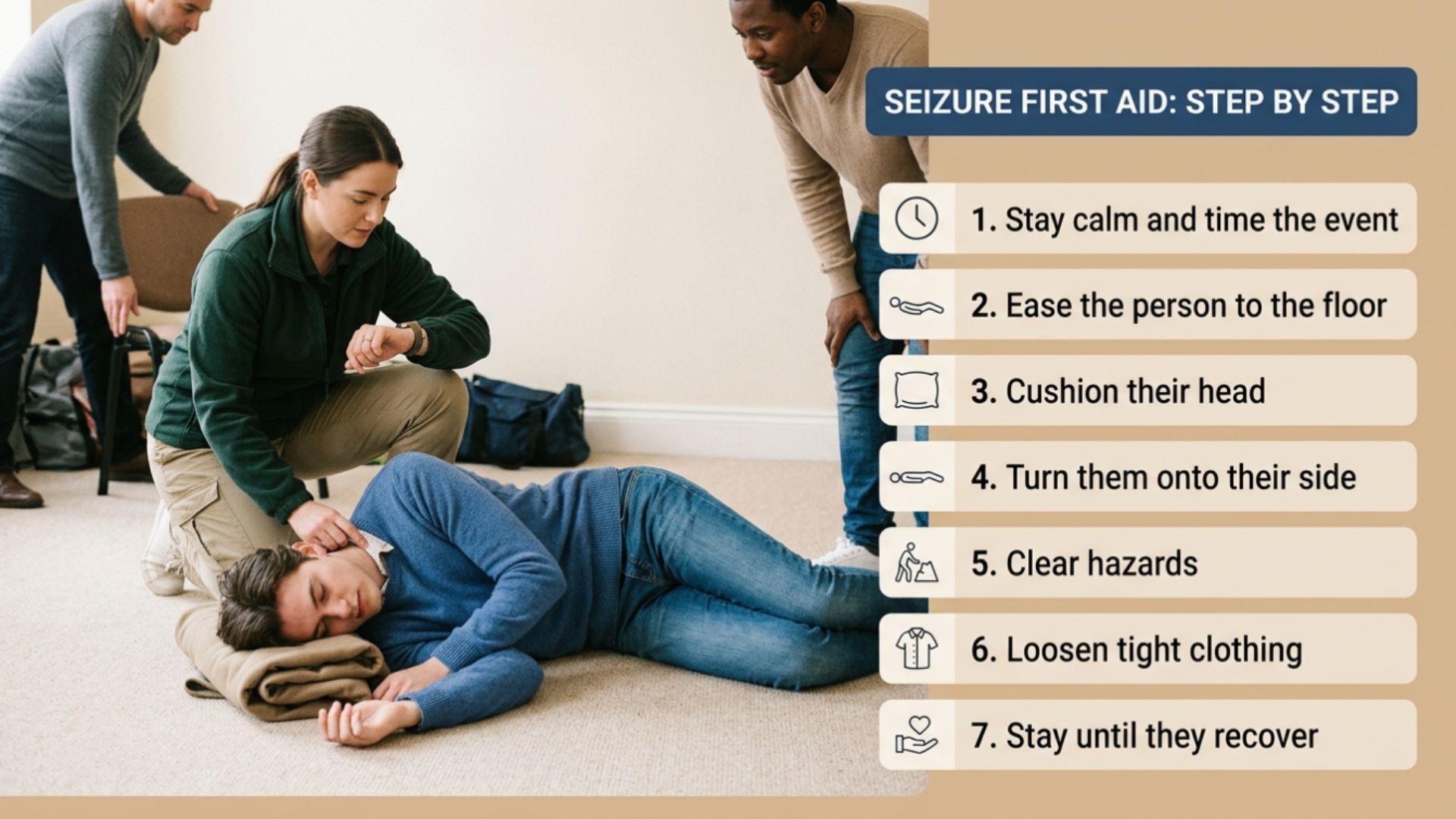 When a generalized event or tonic-clonic episode occurs, your main goal is to protect the person from physical injury while the brain resets. Following clear, simple care steps keeps the individual safe throughout the event.
Essential steps for basic first aid care include:
- Stay calm and time the event: Look at a watch or wall clock. Note the exact time the event started, as duration is critical medical information.
- Ease the person to the floor: Gently help them down to prevent a sudden fall.
- Cushion their head: Place a folded sweater, small pillow, or jacket under their head to protect it from hard surfaces.
- Turn them onto their side: Gently roll the person onto one side (the recovery position) to keep their airway clear and allow fluids to drain safely from the mouth.
- Clear hazards: Move sharp furniture, hard objects, or eyeglasses away from the immediate area.
- Loosen tight clothing: Unbutton tight collars or loosen neckties to ease breathing.
- Stay until they recover: Speak calmly as the person regains consciousness, and help reorient them to their surroundings.
Knowing what not to do is just as crucial when providing immediate support. Caregivers must observe basic seizure precautions to ensure safety: never restrain the person or try to hold down their jerking limbs, as this can cause muscle tears or bone fractures. Additionally, never put anything in the person’s mouth. Contrary to an old myth, a person cannot swallow their tongue during an episode, and inserting objects like spoons or fingers can break teeth, cause severe bite injuries, or block their airway.
Maintaining proper seizure first aid protocols protects both the individual and the caregiver, ensuring a smooth, safe transition into the post-event recovery phase.
Can You Die From a Seizure? Understanding the Risks
It is completely natural to wonder: can you die from a seizure? The vast majority of episodes resolve safely on their own within two or three minutes without causing long-term structural brain damage or fatal complications.
However, serious risks do exist, primarily associated with prolonged events, physical injuries from falls, or rare underlying medical complications. Understanding these risks helps patients and caregivers take practical precautions to protect health and safety.
One serious medical emergency is status epilepticus, defined as a single event lasting longer than five minutes, or multiple events occurring back-to-back without the person regaining consciousness in between. This condition requires emergency medical intervention to stop the continuous electrical activity and prevent neurological damage.
Another rare consideration is Sudden Unexpected Death in Epilepsy (SUDEP), which affects a small percentage of individuals with poorly controlled epilepsy. While the exact causes are still being researched, managing risk factors through consistent care significantly improves safety outcomes. So, while answering can you die from a seizure requires acknowledging these rare realities, working closely with a specialist dramatically reduces your overall risk.
Call 911 immediately if you observe any of the following emergency triggers:
- The episode lasts longer than five minutes.
- The person has difficulty breathing or does not wake up after the jerking stops.
- A second episode starts immediately after the first.
- The event occurs in water (like a pool or bathtub).
- The person is pregnant, injured, or has diabetes.
- It is the person’s very first episode.
When to See a Neurologist About Seizures
Experiencing an unprovoked event for the first time is a significant health event that requires a thorough neurological evaluation. An accurate medical workup helps pinpoint underlying triggers, distinguish between different conditions, and prevent future episodes.
At Lone Star Neurology, our specialists use advanced diagnostic tools to evaluate brain function. Using electroencephalograms (EEG) to measure electrical patterns and high-resolution magnetic resonance imaging (MRI) to inspect brain structure, we identify the cause of a seizure in each case.
Identifying the cause of a seizure allows our team to design a targeted, personalized care plan. Treatment may include modern anti-seizure medications, lifestyle modifications, or specialized therapies aimed at restoring control and improving your overall quality of life.
Living well with epilepsy or a seizure disorder is entirely achievable with the right medical support, steady monitoring, and an individualized care approach. Our team across Dallas-Fort Worth, Austin, Houston, and San Antonio is dedicated to providing compassionate care with dignity and respect.
If you or a loved one has experienced an unexplained episode, don’t wait to seek expert guidance. Learn more about our specialized Epilepsy Treatment options, explore our comprehensive Practice Areas, or reach out directly to schedule an evaluation.
Take the first step toward clear answers and dedicated care. Book an Appointment with a specialist at Lone Star Neurology today, or give our team a call at 214-619-1910 to discuss your needs.

 (87 votes, average: 4.68 out of 5)
 Loading...






I've given up... the stress her office staff has put me through is just not worth it. You can do so much better, please clean house, either change out your office staff, or find a way for them to be more efficient please. You have to do something. This is not how you want to run your practice. It leaves a very bad impression on your business.
Please, leave your review
Write a comment: