

Every summer, someone collapses at a backyard barbecue or a parking lot, and the people around them freeze, not from fear, but from genuine uncertainty. Is it the heat? Is it a stroke? It looks the same in the first seconds, and those seconds matter more than most people realize. Understanding heat stroke vs stroke is not a medical trivia question. It is practical knowledge that can determine whether someone makes a full recovery or doesn’t make it at all.
At Lone Star Neurology, we regularly see the consequences of delayed response. Patients who come in hours after a stroke began because a bystander assumed it was heat exhaustion. Families who didn’t call 911 because the person “seemed to be improving.” This guide exists to close that gap.
Why These Two Emergencies Are So Easily Confused
The overlap in early symptoms is real, and it trips up even people with some medical knowledge. Both conditions can cause sudden confusion, difficulty standing, weakness, and altered behavior. Both tend to happen in summer. Both can escalate from “something seems off” to unconsciousness within minutes.
But the causes are entirely different, and so is what you should do.
In heatstroke, the body’s cooling system fails. Core temperature spikes past 104°F, and the brain begins to suffer from the heat itself. In a stroke, the problem is vascular: blood flow to part of the brain is cut off, or a vessel ruptures, and brain tissue starts dying from oxygen deprivation. The same visible result in the first moments – a person who is struggling. Completely different emergency unfolding underneath.
The challenge with heat stroke vs. stroke is that summer conditions create a risk of both occurring simultaneously. Dehydration thickens the blood, increasing the risk of clotting. Heat dilates blood vessels and drops blood pressure. A hot afternoon can be a setting where an emergency is plausible, which is exactly why knowing the distinguishing signs matters.
What Actually Happens During A Heat Stroke
Heatstroke occurs when the body loses the ability to regulate its temperature and can no longer cool itself quickly enough to keep pace with the heat it’s absorbing or generating.
The threshold is a core body temperature above 104°F. Once that ceiling is crossed, the cascade begins: proteins in cells start to break down, the brain swells, and organs begin to fail. It moves faster than most people expect.
The classic heat stroke symptoms include:
-
- Skin that is hot and dry (or flushed and wet during exertion-related heatstroke)
- Core temperature above 104°F
- Rapid, strong pulse when the heart is working hard to compensate
- Confusion or altered mental state, the person may seem drunk, combative, or unresponsive
- No sweating in classic heatstroke (though exertional heatstroke may involve heavy sweating)
- Nausea, headache, and dizziness in the earlier stages
One detail worth knowing: heat stroke symptoms can develop after a person moves indoors. The body temperature continues rising for a period even after the heat source is removed. This is why “they seemed better in the car” can be dangerously misleading.
The Lone Star Neurology network covers 18 locations across the DFW area, including Arlington, Frisco, McKinney, and beyond, precisely because access to care close to home matters when time is a factor.
What Actually Happens During A Brain Stroke
A stroke is a brain emergency, not a cardiovascular one in the traditional sense, though the vascular system is the mechanism. Roughly 87% of strokes are ischemic, meaning a clot blocks an artery feeding the brain. The remaining cases are hemorrhagic, where a vessel bursts and blood presses into the brain tissue.
In either case, the result is the same: neurons stop receiving oxygen. Brain cells begin dying within four minutes. The longer blood flow is interrupted, the larger the region of damage, and the more permanent the consequences for movement, speech, memory, and cognition.
The core stroke symptoms develop suddenly and without a clear triggering event. There is no gradual build-up. A person may be mid-sentence and simply stop making sense. They may try to stand and find that one side of their body doesn’t respond. These are not symptoms that “might go away with rest.”
Key stroke symptoms to recognize immediately:
- Sudden facial drooping, especially on one side
- Arm weakness or numbness – one arm drifts downward when both are raised
- Speech difficulty – slurred, strange, or absent speech
- Sudden severe headache with no known cause (common in hemorrhagic stroke)
- Vision changes – blurred, double, or loss of vision in one eye
- Loss of balance or coordination appearing without warning
Unlike heatstroke, stroke symptoms do not improve with cooling, fluids, or rest. They are neurological, and they require imaging and intervention, not a glass of water and shade.
Side-By-Side: Key Symptoms That Set Them Apart
When you’re standing next to someone who has just collapsed, you need a fast framework. Here is the clearest comparison:
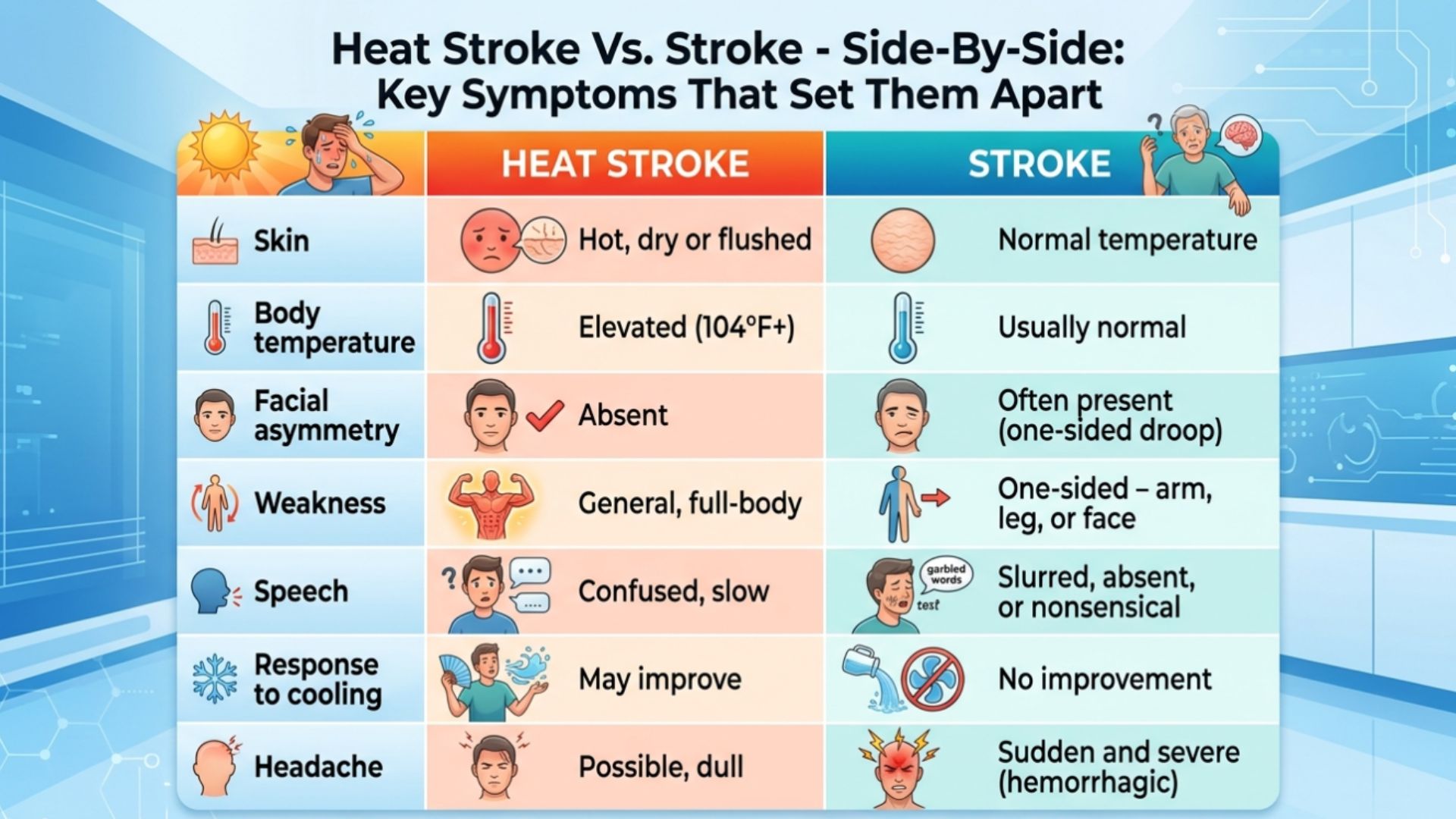
The BE FAST stroke recognition framework is the fastest tool in your toolkit for stroke, specifically:
- Balance: sudden loss of balance
- Eyes: sudden vision change
- Face: facial drooping on one side
- Arms: one arm drifts down
- Speech: slurred or strange
- Time: call 911 immediately
If any of these signs appear, you are not waiting to see if things improve. Stroke warning signs do not resolve on their own, and acting on them early is the single most effective thing a bystander can do.
First-Response Steps That Can Save A Life
Both conditions are emergencies. Neither is a “wait and see” situation. Here is what to do in the first minutes:
- Call 911 first in both cases. Don’t drive to the hospital yourself – paramedics can begin assessment and treatment en route, and they can alert the receiving team. Note the exact time symptoms started. This information directly affects treatment decisions for stroke.
- If you suspect heatstroke: Move the person to shade or air conditioning immediately. Remove excess clothing. Begin active cooling – wet cloths on the neck, armpits, and groin, or a fan with misting. Do not give fluids if the person is confused or not fully conscious.
- If you suspect a stroke: Do not give food, water, or medication. Keep the person calm and still. Note which symptoms appeared and when. Do not let them “walk it off.” The stroke warning signs you observed will be important for the emergency team.
- If you genuinely cannot tell: Treat it as a stroke. Call 911, do not attempt to cool aggressively, and report all symptoms you observed. Emergency teams are trained to assess and differentiate on arrival.
Trust Lone Star Neurology For Fast Stroke Care
Stroke is not just an emergency – it is the beginning of a long road that requires specialized neurological care. The acute phase is only the first chapter. After stabilization, patients often face challenges with movement, language, cognition, and emotional regulation. The quality of ongoing care shapes how much of that function is recovered.
Stroke treatment Texas patients can access at Lone Star Neurology includes the full continuum: initial neurological assessment, advanced imaging, individualized rehabilitation planning, and long-term follow-up designed to reduce the risk of recurrence. Our team of board-certified neurologists works across 18 DFW locations, which means that Texas patients with stroke don’t have to travel far to access care that meets their needs.
We are a licensed, credentialed practice with specialists who focus specifically on cerebrovascular conditions. If you or someone close to you has experienced stroke symptoms, even briefly, even if they seemed to resolve, this warrants evaluation. Symptoms that disappear on their own may signal a transient ischemic attack (TIA), which is a significant warning sign for a future stroke.
Don’t wait for a second event to take action. Lone Star Neurology is here to help you understand what happened, what your risk looks like, and what the right next steps are.
If you are experiencing symptoms of a stroke right now, call 911 immediately. Do not drive yourself to a clinic.

 (83 votes, average: 4.71 out of 5)
 Loading...





I've given up... the stress her office staff has put me through is just not worth it. You can do so much better, please clean house, either change out your office staff, or find a way for them to be more efficient please. You have to do something. This is not how you want to run your practice. It leaves a very bad impression on your business.
Please, leave your review
Write a comment: