

Imagine tipping your head back to rinse shampoo at the sink, and suddenly the room lurches into a violent spin. It lasts less than a minute, passes, and then, days later, it happens again the moment you look up at a top shelf. If this sounds familiar, there’s a name for it: benign paroxysmal positional vertigo, or BPPV for short.
The name sounds alarming. The condition usually isn’t. BPPV is mechanical; it’s one of the most common causes of vertigo we see, and most cases resolve in one or two office visits with a simple repositioning technique called the Epley maneuver. This article explains what causes BPPV, how the maneuver works, and when spinning may signal something that needs a neurologist’s attention.
This article is for general educational purposes and is not a substitute for a medical evaluation. Please consult a physician from Lone Star Neurology before attempting any treatment.
What Causes BPPV?
Inside your inner ear sits a structure called the utricle, home to tiny crystals made of calcium carbonate called otoconia. Normally, these crystals rest in a gel layer and help your brain sense gravity and movement. In benign paroxysmal positional vertigo, some of these crystals break loose and drift into one of the semicircular canals, the fluid-filled loops that detect rotation. Once they’re there, ordinary head movements send fluid sloshing past them, and your brain receives a false signal that you’re spinning when you’re actually still.
Why do the crystals come loose in the first place? Age is the biggest factor; the structures holding them in place naturally degrade over the decades. Head injury, prolonged bed rest, and inner-ear infections are also common triggers. In a large share of cases, though, no clear cause is ever found, and that’s frustrating but not unusual.
If you’re curious about BPPV, what do ear crystals look like? The honest answer is: nothing you’d ever see. Otoconia range from about 1 to 30 micrometers, smaller than a grain of table salt by a wide margin, and they’re only visible under a microscope (PMC, otoconia morphology study). The “crystal” imagery is useful for understanding the mechanism, but there’s no actual sand in your ear to feel or shake loose on your own.
Typical BPPV Symptoms
The signature pattern of BPPV symptoms is brief, intense, and tied to specific positions. Rolling over in bed, looking up, bending down to tie a shoe – these movements trigger a spinning sensation that typically lasts anywhere from a few seconds to under a minute. Nausea often comes along for the ride, and many people feel lingering unsteadiness even after the spinning stops.
Here’s what BPPV does not cause, and the distinction matters more than almost anything else in this article:
- Hearing loss
- Ringing in the ears
- Fainting or loss of consciousness
- Headache
- Weakness, numbness, or slurred speech
If any of those show up alongside the dizziness, it’s a signal that something other than BPPV is going on, and it’s exactly why this pattern sends patients to a neurologist rather than just an ENT.
How Long Does BPPV Last?
How long does BPPV last depends on which question you’re actually asking. Each spinning episode is short, usually under a minute. But left untreated, the condition can keep recurring for weeks or even months before it settles on its own, since a fair share of cases eventually resolve without any intervention.
The good news is that BPPV treatment with a repositioning maneuver usually shortens that timeline dramatically, often to one or two visits. Recurrence does happen in a meaningful minority of patients. A Cochrane review following patients for up to four years found recurrence in as many as 36% of cases (Cochrane Database of Systematic Reviews), and older age, a history of head trauma, and prior BPPV episodes all raise the odds of it coming back. This is why it helps to know the pattern and come back in if it returns.
The Epley Maneuver, Step by Step
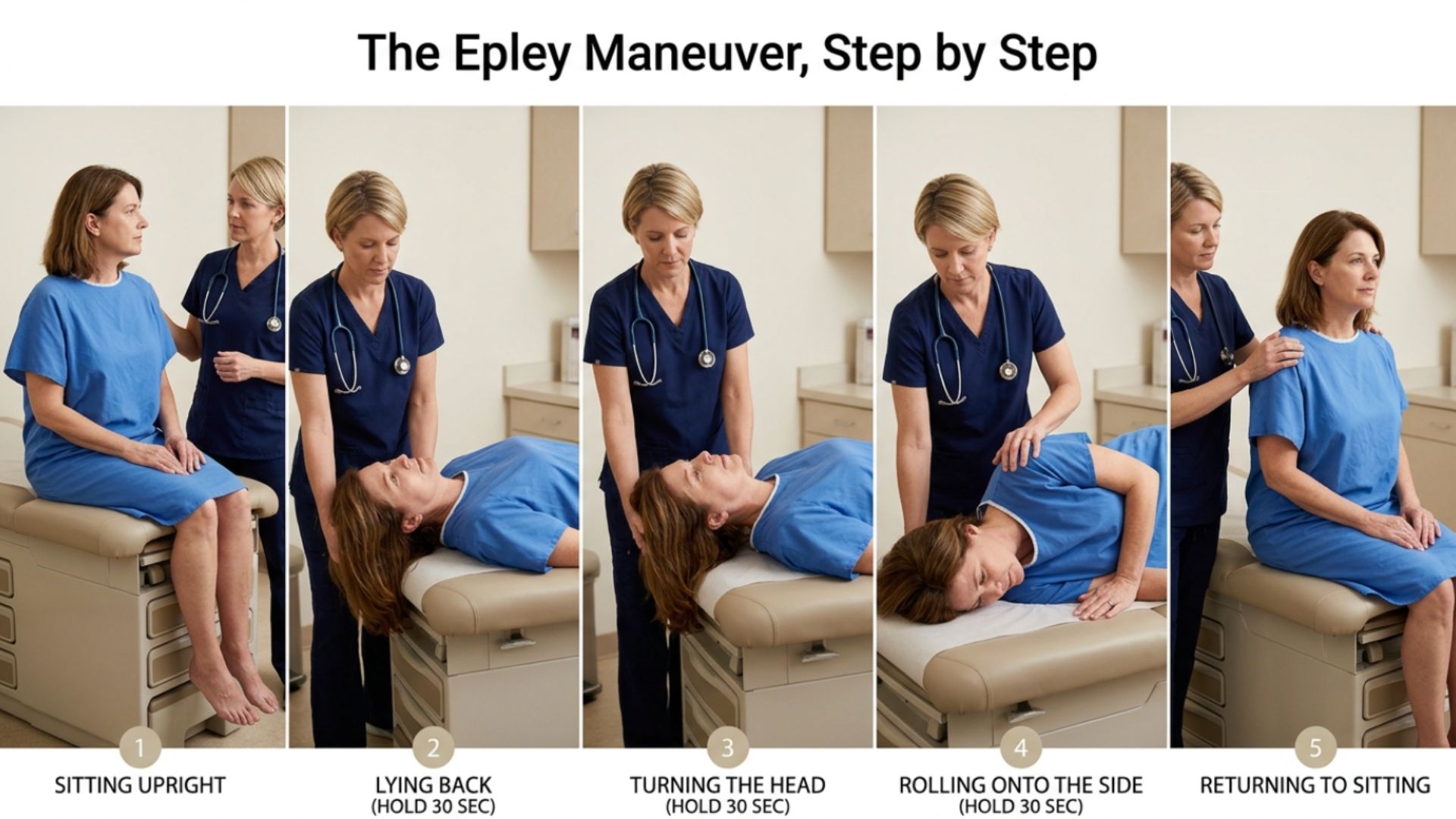
The Epley maneuver works by guiding the displaced crystals back out of the semicircular canal and into a part of the inner ear where they no longer trigger false motion signals. It’s a sequence of head positions, each held for about 30 seconds, performed in a specific order:
- Sit upright on an exam table with your head turned 45 degrees toward the affected side.
- Lie back quickly so your head hangs slightly off the edge, still turned, and hold for 30 seconds.
- Turn your head 90 degrees to the opposite side without lifting it, and hold again.
- Roll your entire body onto that side so you’re facing the floor, and hold once more.
- Slowly return to a seated position.
The order matters because each position walks the crystals along the curve of the canal, using gravity to move them step by step back to where they belong. This is a clinical explanation of what happens during an office visit, not a substitute for an actual exam, since identifying the correct affected ear first is essential to doing it right.
That said, a version of the Epley maneuver at home is reasonable for people who’ve already been diagnosed and shown the correct side by a clinician. Doing the Epley maneuver at home without knowing which ear is affected can make symptoms worse rather than better, which is the most common mistake people make trying this from a video alone. Anyone with neck problems, a recent spine injury, or significant balance issues should skip the home version and stick with office visits. If you do attempt it at home, do it on a bed with someone nearby in case the spinning brings on nausea or unsteadiness.
Clear Epley maneuver instructions, paired with an Epley maneuver video demonstration, tend to work better together than either alone, since watching the head positions in motion clarifies details that are easy to misread from text. For posterior canal BPPV that doesn’t respond to Epley, or for patients who can’t tolerate the neck extension it requires, other BPPV exercises like the Semont or Brandt-Daroff maneuvers serve as alternatives.
In-Office Treatment and What to Expect
Before any repositioning, a clinician confirms the diagnosis with the Dix-Hallpike test. This position change reproduces the vertigo and reveals a specific eye movement pattern (nystagmus) that confirms both the diagnosis and which ear is affected. This step is what separates a properly performed Epley maneuver from a guess.
BPPV treatment guidelines from the American Academy of Otolaryngology-Head and Neck Surgery Foundation recommend repositioning maneuvers as first-line therapy, and specifically recommend against routine use of vestibular suppressant medications like antihistamines, since they don’t address the mechanical cause and can mask the response to treatment (AAO-HNS Clinical Practice Guideline). Success rates after one to three sessions are consistently high across the research, with some studies showing resolution in most patients after a single treatment.
Mild unsteadiness for a day or two afterward is normal. Patients are generally advised to move around normally rather than staying still, since gentle activity helps. If spinning returns, follow-up treatment usually resolves it again. If patients have residual imbalance after the crystals have been repositioned, BPPV exercises through formal vestibular rehabilitation therapy can help retrain the brain’s balance response over the following weeks.
When Vertigo Needs a Neurologist
Some symptoms alongside vertigo mean urgent care, not a scheduled appointment: double vision, slurred speech, facial drooping, one-sided weakness, a severe new headache, or sudden trouble walking. These can point to a stroke or other central nervous system event, and time matters.
For everyone else, book a neurology visit if vertigo comes with hearing loss or ringing, if it doesn’t fit the positional pattern described here, or if spinning keeps returning despite repositioning treatment. Dizziness that gets written off for months is a familiar story; the same delayed-recognition pattern shows up with early signs of Alzheimer’s and dementia, where subtle symptoms are dismissed until they interfere with daily life.
If it’s been a while since anyone actually examined your ears and eye movements rather than just asking about symptoms, that’s usually the missing piece. Not all spinning is positional, either; some patients whose dizziness doesn’t track with head movement at all turn out to have a form of vertigo tied to migraine instead, which needs a different treatment approach entirely and is another reason an accurate diagnosis is worth getting rather than guessing at home.
Lone Star Neurology provides BPPV treatment for patients across Texas, including Dallas, Plano, Frisco, McKinney, Allen, Richardson, Carrollton, Denton, Fort Worth, Arlington, Austin, San Antonio, and Houston. Call 214-619-1910 or book online.
Disclaimer: This article is intended for general educational purposes and does not replace a medical evaluation. Do not attempt to self-diagnose or perform repositioning maneuvers without prior guidance from a Lone Star Neurology healthcare provider, especially if you have neck or spine conditions.

 (131 votes, average: 4.67 out of 5)
 Loading...







I've given up... the stress her office staff has put me through is just not worth it. You can do so much better, please clean house, either change out your office staff, or find a way for them to be more efficient please. You have to do something. This is not how you want to run your practice. It leaves a very bad impression on your business.
Please, leave your review
Write a comment: