

An EEG test (electroencephalogram) records the brain’s electrical activity through small sensors placed on the scalp, and it’s one of the most common tools neurologists use to look into seizures, fainting spells, and unexplained confusion. It’s painless, involves no radiation, and the wires only listen; they don’t send any current into your head. A routine appointment usually takes about an hour, most of it spent setting up.
Still, people get nervous, and honestly, that makes sense. Twenty-odd wires glued to your hair sounds strange if nobody has explained it. So here’s what actually happens, from the night before to the day the report comes back.
What an EEG Measures and Why Your Doctor Ordered One
What is an EEG test measuring, exactly? Nerve cells in the brain communicate with tiny electrical signals, constantly, whether you’re thinking hard or half asleep. Electrodes on the scalp pick up the combined activity of millions of those cells, and a computer draws it as wavy lines over time.
That’s the key difference from CT or MRI. Those scans show structure: what the brain looks like. An EEG shows function, how it’s behaving in the moment, and it produces no picture of brain tissue at all. If you’ve had an MRI before, you’ll notice the experience is nothing alike (no tube, no noise), and the MRI preparation guide covers a very different set of steps.
So what is an EEG good for? Mostly epilepsy. It can catch the spikes and sharp waves, called epileptiform discharges, that suggest a tendency toward seizures, and it helps tell one seizure type from another, which changes which medication makes sense. If you’re still sorting out what a seizure is versus a faint, the recording is often part of that answer.
What does an EEG test for beyond epilepsy? Depending on why you were referred, doctors use it to:
- look into episodes of confusion, staring, or “zoning out”
- check for seizures that don’t cause obvious shaking
- evaluate someone unresponsive for a long time
- study brain activity during sleep in some sleep disorders
- spot areas of slowing that can follow a head injury, stroke, or infection
How to Prepare: Hair, Medication and Sleep
Good preparation is mostly about one thing: getting the electrodes to sit firmly against clean skin. Your clinic’s instructions come first, since a routine EEG procedure and a sleep-deprived one are prepared a little differently.
- Hair. Wash it the night before or that morning and skip conditioner, oils, sprays, and gels. Avoid braids or extensions if you can, because the technician needs to reach your scalp.
- Medicines. Keep taking everything as prescribed, seizure medications included, unless your neurologist specifically says otherwise. Stopping an anticonvulsant on your own can trigger a seizure.
- Food and caffeine. Eat normally; an empty stomach can actually distort the recording. Coffee, energy drinks, and caffeinated soda are usually off the table for 8 to 12 hours before.
- Sleep. For a sleep-deprived EEG, you’ll be asked to sleep much less than usual the night before, sometimes only four or five hours, sometimes not at all. Being tired makes certain abnormal patterns more likely to show up, and many people drift off on the table, which is exactly the point.
If it’s the sleep-deprived version, please don’t drive yourself home. Ask someone to come with you, or arrange a ride.
In the Room: Step by Step
A routine EEG procedure follows a pretty predictable order, and the technician tells you what’s coming at each stage.
1. Measuring. The technician measures your head and marks the spots for each electrode with a washable pencil. This takes 5 to 10 minutes and follows an international placement system, so every lab puts sensors in the same places.
2. Attaching. About 20 to 25 small metal discs go on with a sticky conductive paste, or, for some patients, a stretchy cap with the electrodes already built in. Expect 15 to 30 minutes here, mostly spent scrubbing tiny patches of scalp so the signal comes through clearly.
3. Recording. You lie back or sit in a reclining chair and stay as still as you comfortably can. The technician will ask you to open and close your eyes, and usually to breathe deeply and quickly for about three minutes.
4. Flashing lights. A strobe set in front of your face flickers at different speeds while your eyes are closed, then open. It’s a little odd, but it isn’t painful.
5. Removing. Electrodes come off with warm water, and you’re free to go.
So, how long is an EEG test overall? The recording itself usually lasts 20 to 40 minutes, though some labs run up to 90. With setup and cleanup, plan for roughly an hour. A sleep-deprived study often runs longer, since part of the goal is to record you while you nap. Many labs also film the session, so if anything happens during the EEG test, doctors can match what they see on video to the waves on screen.
Is It Safe? Side Effects and the Honest Answers
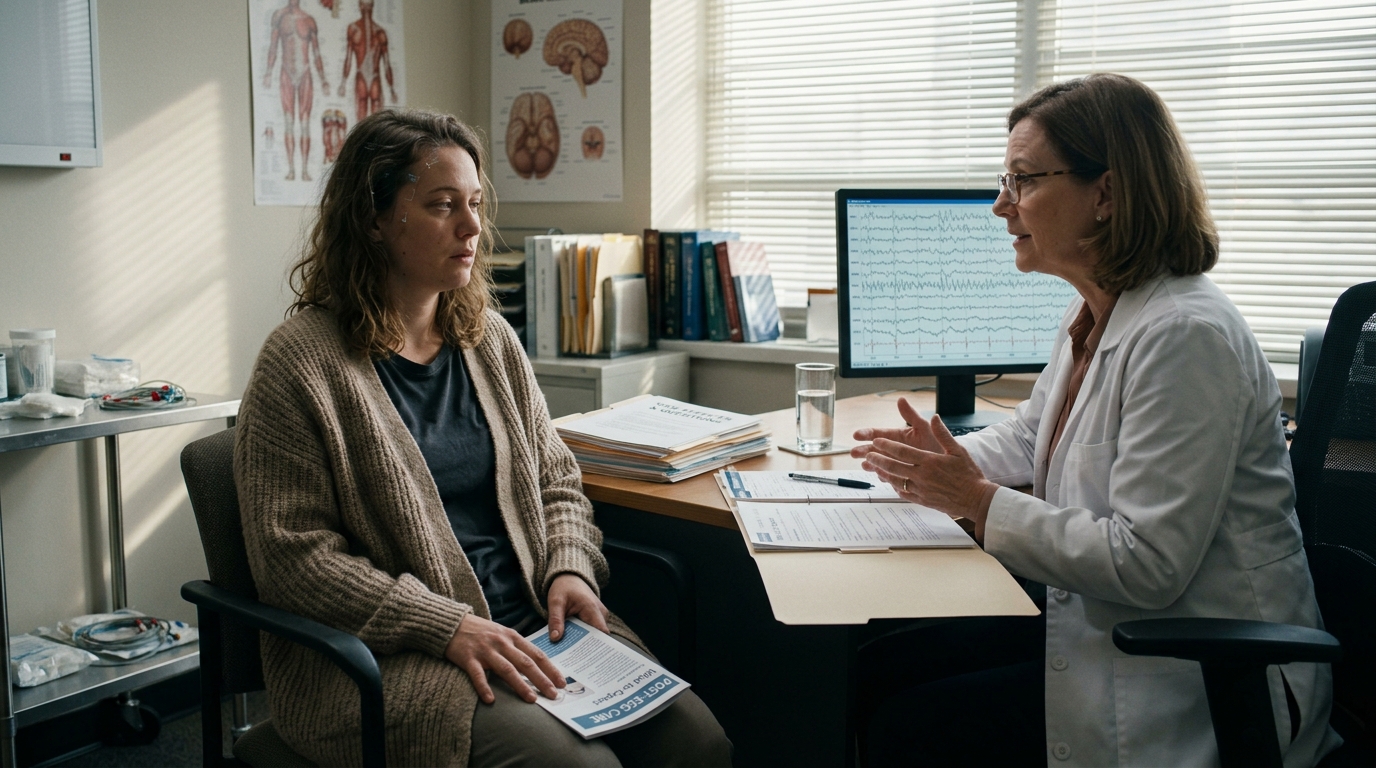
Yes, for nearly everyone. Nothing is injected, nothing goes through the skin, and there’s no radiation, so it’s routinely done in babies, children, and pregnant women. The EEG test side effects people actually notice are minor and short-lived:
- sticky, slightly greasy hair until your next shampoo
- a few red or itchy spots where the paste was scrubbed in, usually gone within a day
- lightheadedness or tingling fingers during the fast-breathing part; tell the technician, and they’ll stop it
- heavy tiredness after a sleep-deprived EEG, which is why the ride home matters
The one real risk is a seizure. Flashing lights or hyperventilation can trigger one in people who are prone to them, mostly in those with photosensitive epilepsy. That’s rare, and frankly it’s part of why the test is done in a supervised setting: a technician is right there, and the episode itself becomes useful diagnostic information.
Please mention pregnancy, recent head surgery, skin conditions on the scalp, or a history of seizures when you book. None of these usually stops the test, but they change how it’s run. Overall, EEG side effects are far less of a concern than most patients expect.
Getting Your Results, and What a Normal EEG Does Not Rule Out
You won’t get an answer before you leave. The technician records the tracing; a neurologist trained to read it interprets it afterward, usually within a few days to a week. EEG test results describe the overall background rhythm, whether it fits your age and state of alertness, and whether any specific abnormalities appeared, such as epileptiform discharges or areas of slowing.
Those findings never stand alone. Your doctor weighs EEG test results against your history, eyewitness descriptions of the episodes, and other tests like MRI or bloodwork.
Here’s what surprises people. A normal EEG test means nothing abnormal happened during that specific 30 or 40 minutes. It doesn’t prove a seizure never occurred, and it doesn’t rule out epilepsy. In fact, a first routine EEG picks up epileptiform activity in only about 29% to 55% of people who do have epilepsy; repeat recordings and sleep raise that number considerably.
If episodes keep happening but the first recording comes back clean, your neurologist may suggest a sleep-deprived repeat or ambulatory monitoring, where you wear a portable recorder at home for 1 to 3 days. Longer recordings simply give the brain more chances to show what it’s doing. Our epilepsy treatment team uses these results to decide on next steps, including whether medication is needed at all.
Cost, Coverage and Booking an EEG in Dallas-Fort Worth
There’s no single EEG test price in Dallas-Fort Worth. What you pay depends on the type of study, how long it records, where it’s done, and your insurance plan. A routine recording in a neurology office often costs less than the same test in a hospital, where facility fees get added on top. Ambulatory and video monitoring cost more than a standard session.
A few things worth sorting out before the appointment:
- Ask for an estimate. Request the EEG test price for your specific study, and confirm whether it includes the neurologist’s reading, not just the recording.
- Call your insurer. Most plans cover an EEG when it’s medically necessary, but deductibles and prior authorization vary a lot. Our office can help verify your coverage ahead of time.
- Check the referral. Some plans require one from a primary care doctor or neurologist.
- Share the details. When you schedule, mention your symptoms, medications, earlier test results, and whether you’ve been told to arrive sleep-deprived.
Lone Star Neurology performs the EEG procedure in-office across Dallas-Fort Worth, including our Carrollton location, and you can read what to expect from other studies on our tests and procedures page. To schedule an EEG test, call 214-619-1910 or book an appointment online. Bring your insurance card, the referral if you need one, and clean, product-free hair.
This article is for general education and doesn’t replace a consultation with a doctor. Follow the preparation instructions your own clinic gives you, and never stop a prescribed medication without talking to your neurologist.
 (No Ratings Yet)
 Loading...








I've given up... the stress her office staff has put me through is just not worth it. You can do so much better, please clean house, either change out your office staff, or find a way for them to be more efficient please. You have to do something. This is not how you want to run your practice. It leaves a very bad impression on your business.
Please, leave your review
Write a comment: