

At 10 am, a retired engineer jokes with the receptionist and remembers the name of his first boss from 1971. By 3 pm the same day, he can’t follow a simple conversation and insists a small child is sitting quietly in the corner of the living room. His wife mentions, almost as an afterthought, that he has been punching and shouting in his sleep for years.
Each moment on its own looks like something else: a bad afternoon, an eyesight problem, a rough night. Put together, they form one of the most recognizable patterns in neurology.
That pattern is Lewy body dementia, and three features set it apart:
- thinking and alertness that swing dramatically from hour to hour
- vivid visual hallucinations early in the illness
- movement changes that closely resemble Parkinson’s disease
According to the National Institute of Neurological Disorders and Stroke, this disorder is not rare. It is one of the most common forms of degenerative dementia. Early Lewy body dementia symptoms are still regularly mistaken for Alzheimer’s, Parkinson’s, or even a psychiatric illness. The correct name matters because it changes Lewy body dementia treatment, including which common medications can cause serious harm.
What Is Lewy Body Dementia?
So, what is Lewy body dementia at the brain level? Nerve cells contain a protein called alpha-synuclein. In this disease, it clumps into abnormal deposits known as Lewy bodies.
Think of sludge building up in a fuel line. The engine still runs, but it sputters, stalls, and misfires.
These deposits damage cells that produce two key chemical messengers:
- Acetylcholine, which supports attention and memory
- Dopamine, which supports movement, mood and sleep
That is why thinking, movement, mood and sleep can all be affected at the same time. The biology is shared, and over time the two often look alike. If the overall picture of cognitive decline still feels confusing, it helps to understand how dementia differs from Alzheimer’s disease.
Families often ask: Is Lewy body dementia hereditary? In most cases, no. Most people have no clear family pattern. Having a parent or sibling with this condition or with Parkinson’s may raise risk slightly, and a few gene variants have been linked to it. Age remains the biggest factor, and men are affected more often, alongside other risk factors for dementia.
Early Signs Families Notice First
What are the first signs of Lewy body dementia? Surprisingly often, memory is not one of them:
- Acting out dreams. A person punches, kicks, or yells during sleep. This is REM sleep behavior disorder, and it can appear years before any thinking problems. In a multicenter study published in Brain that followed 1,280 patients, about 73% of people with this sleep disorder developed Parkinson’s disease, dementia with Lewy bodies, or a related condition within 12 years. Confirming it usually requires an overnight study, similar to how doctors diagnose other sleep disorders.
- Fluctuating alertness. Long staring spells, heavy daytime sleepiness, and muddled speech that clears after an hour.
- Attention and visual judgment problems. Misjudging a step, struggling to park, or getting lost on a familiar route.
- Loss of smell, stubborn constipation, and dizziness or fainting when standing up.
Hallucinations and Movement Symptoms
Lewy body dementia hallucinations are usually visual and remarkably detailed: a cat curled on the sofa, children playing in the hallway, a stranger sitting at the dinner table. At first they are often not frightening. Many people keep their insight early on and say something like, “I know that dog isn’t really there, but I can see it.”
The movement side is called parkinsonism. It can include:
- stiffness and slowness
- a shuffling walk with less arm swing
- a “masked,” less expressive face
- a softer voice
- falls
Tremor tends to be less prominent than in classic Parkinson’s. Why do these symptoms matter so much together? The 2017 international consensus criteria published in Neurology list four core features: fluctuating cognition, visual hallucinations, REM sleep behavior disorder, and parkinsonism. When two or more appear in someone with dementia, the diagnosis becomes probable.
Stages and What to Expect Over Time
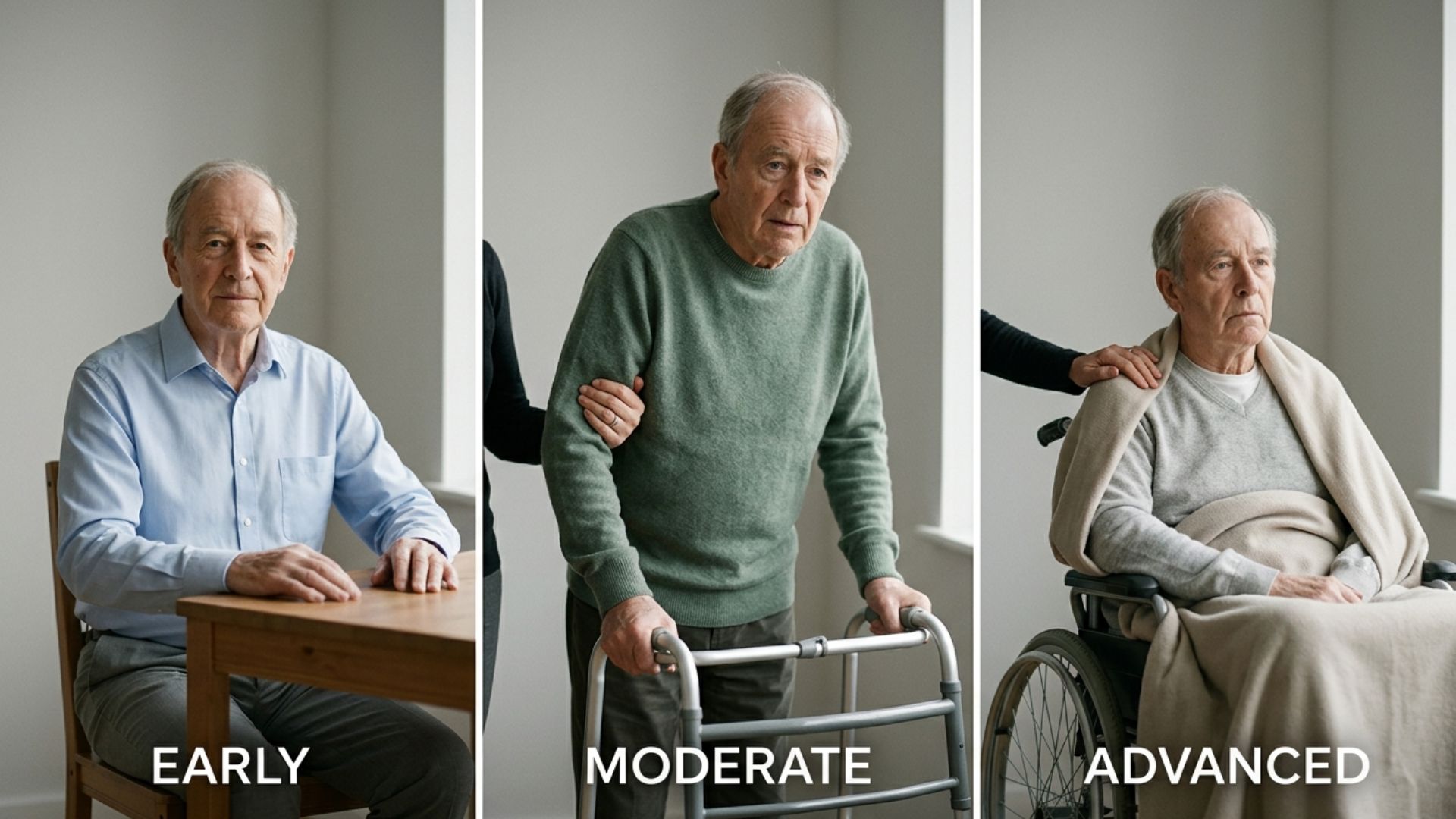
Staging this disease is less precise than with other dementias because fluctuation is built into it. The same person can seem “moderate” at breakfast and “advanced” by dinner. Still, Lewy body dementia stages are commonly described in three broad phases.
- Early: mild thinking changes, dream enactment, occasional hallucinations. Most people remain largely independent, though driving and finances warrant closer attention.
- Moderate: more help needed with daily tasks, clearer stiffness and slowness, more falls, more frequent hallucinations or false beliefs, early swallowing changes.
- Advanced: significant care needs, limited speech, high fall risk, and swallowing problems that raise the risk of pneumonia.
The 7 stages of Lewy body dementia you may find online are usually borrowed from a scale designed for Alzheimer’s. That scale tracks steady memory decline, which this condition rarely follows. It works as a rough map, not a timetable.
On Lewy body dementia life expectancy, a meta-analysis in Ageing Research Reviews of 11 studies found an average survival of about 4.1 years after diagnosis, compared with about 5.7 years for Alzheimer’s. Averages hide a wide range, though. Many people live considerably longer, and age, general health, fall prevention, and swallowing care all play a part.
An early diagnosis buys time to plan calmly. Families can make legal decisions, pad the bedroom against nighttime wandering, add grab bars, and learn practical strategies for caring for a parent with dementia at home.
Diagnosis, Treatment and Medications to Avoid
No single test diagnoses this condition. Diagnosis usually combines several steps:
- History from both patient and family. Relatives often notice the fluctuations and sleep behaviors that a patient misses on a good day.
- Cognitive testing focused on attention and visual skills, such as copying overlapping shapes or drawing a clock.
- Neurological examination for stiffness, slowness, and balance.
- Brain imaging to rule out other causes; a DaTscan can show reduced dopamine activity.
- A sleep study to confirm REM sleep behavior disorder.
The Lewy body dementia vs Alzheimer’s distinction is clearest early on. Alzheimer’s typically starts with memory loss: repeated questions, forgotten conversations. Lewy body disease more often starts with attention problems, visual confusion, hallucinations, and movement changes, while memory stays relatively intact.
No treatment stops the disease, but several approaches can make daily life noticeably better:
- Cholinesterase inhibitors (such as donepezil or rivastigmine) often improve alertness, thinking, and hallucinations, sometimes more clearly than in Alzheimer’s. Possible side effects include nausea, weight loss, a slower heart rate, and, occasionally, worsening tremor.
- Movement medications like levodopa may ease stiffness but can intensify hallucinations, so doses are adjusted carefully.
- Treatment for dream enactment may involve melatonin or clonazepam; the latter can cause daytime drowsiness and falls.
- Non-drug approaches to hallucinations include better lighting, fewer shadows, an eye exam, gentle reassurance instead of arguing, and a review of medications that can worsen confusion.
Getting an Accurate Diagnosis in Texas
A wrong label carries real costs. Someone treated as having “just Alzheimer’s” may receive a sedating antipsychotic during a hospital stay, or no one may connect the falls, the nighttime thrashing, and the hallucinations. An accurate diagnosis leads to safer medication choices, better Lewy body dementia treatment, and support that fits the disease.
Some changes are worth a neurological evaluation now rather than “if it gets worse”:
- confusion that comes and goes during the day
- seeing people or animals that aren’t there
- acting out dreams during sleep
At Lone Star Neurology, the memory clinic, movement disorder care, and the Sleep Disorder Center work within one practice. That matters here, because Lewy body dementia symptoms touch all three areas at once. MRI appointments are also available on Saturdays, which helps working family members who come along.
Families don’t have to navigate what comes next alone. Through the free GUIDE dementia support program, funded by Medicare, eligible patients referred by their provider receive a dedicated Care Navigator, a personalized care plan, round-the-clock helpline access, and connections to local caregiver resources.
Lone Star Neurology has clinics across North Texas, from Sherman and Greenville to Fort Worth and Mansfield, as well as in Austin, Houston, and San Antonio. To schedule an evaluation, call 214-619-1910, or book online.
This article is for informational purposes only and does not replace professional medical advice. Please don’t self-treat; consult a qualified physician about any symptoms or medications.
 (No Ratings Yet)
 Loading...







I've given up... the stress her office staff has put me through is just not worth it. You can do so much better, please clean house, either change out your office staff, or find a way for them to be more efficient please. You have to do something. This is not how you want to run your practice. It leaves a very bad impression on your business.
Please, leave your review
Write a comment: