

One side of your face stops moving – not gradually, but overnight. You can’t smile, can’t close your eyes fully, and the person in the mirror looks unfamiliar. The first instinct is often to think of a stroke. In many cases, the actual diagnosis is Bell’s palsy, and the prognosis is considerably better than that fear suggests.
What is Bell’s palsy? This question brings immediate relief to most patients once it’s answered. It is a temporary inflammation of the facial nerve that produces weakness or paralysis of the muscles on one side of the face. It is the most common cause of peripheral facial weakness in adults; it can occur at any age, and in the majority of cases, the nerve recovers, particularly when treatment is started early. Understanding the condition, its causes, and what recovery looks like helps patients engage with their care more effectively and avoid the anxiety that comes from not knowing what’s happening to their own face.
What Is Bell’s Palsy, and How Does Facial Paralysis Actually Develop
What is Bell’s palsy, at a mechanical level? What anatomy of the facial nerve is involved? This nerve originates in the brainstem and travels through a narrow bony canal in the skull before branching into the muscles that control facial expression, eyelid closure, smiling, and eyebrow raising. It also carries fibers involved in tearing, taste on the front of the tongue, and sound sensitivity.
When the facial nerve becomes inflamed – for reasons discussed below – the surrounding tissue swells within the confined space of that bony canal. The swelling compresses the nerve, disrupting its normal ability to transmit electrical signals to the facial muscles. The result is Facial paralysis Bell’s palsy produces: the muscles on the affected side weaken or stop responding, sometimes over the course of hours.
The speed of onset is one of the most alarming features of the condition. Many patients go to bed feeling normal and wake up with asymmetry, or notice the change developing over the course of an evening. This abruptness is actually characteristic of Bell’s palsy and helps differentiate it from stroke, where other neurological signs – limb weakness, speech disturbance, altered consciousness – are typically also present. A neurological examination that rules out those additional findings is how the distinction is made.
Bell’s Palsy Causes And The Role Of Viral Infection
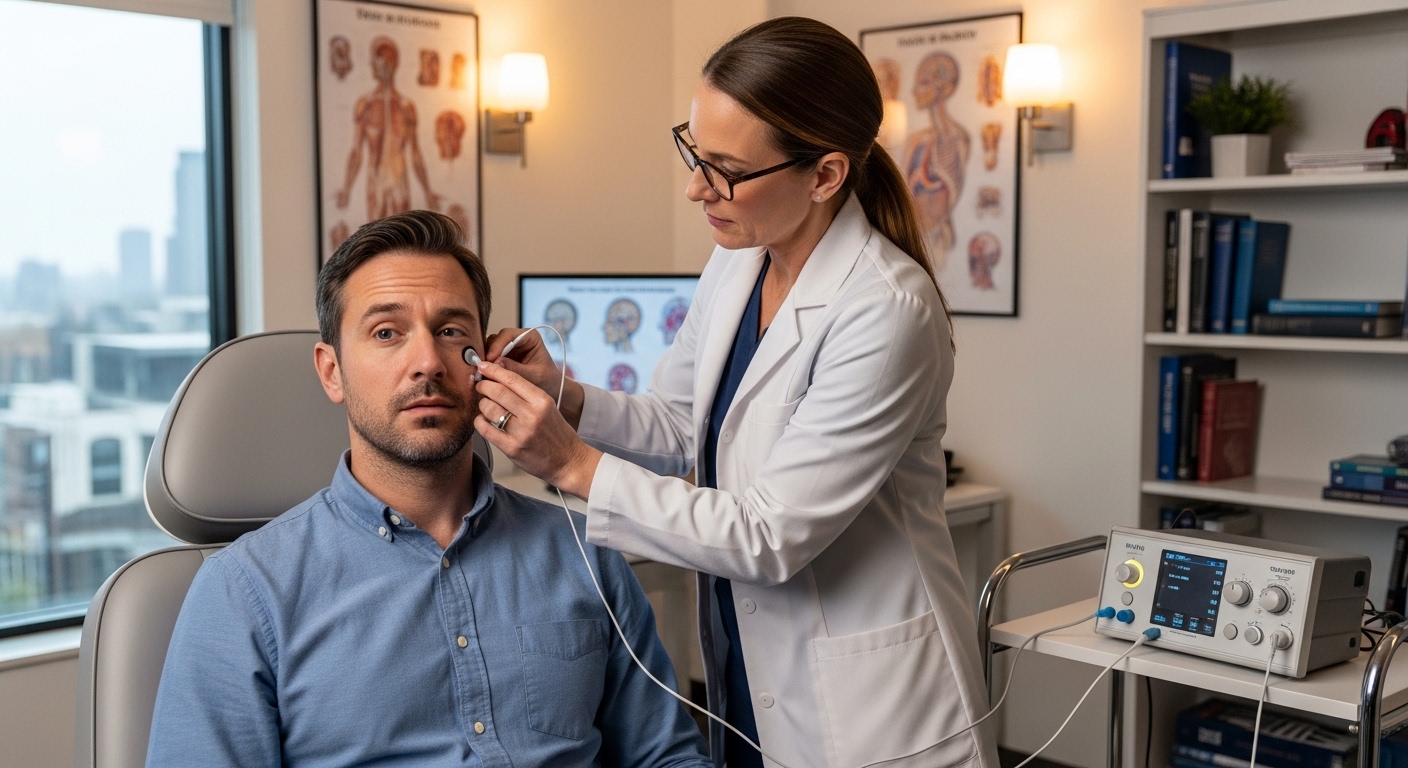
Bell’s palsy causes are not always definitively identified, which is part of what makes the condition feel mysterious to patients. In many cases, a specific trigger cannot be confirmed. What is consistently supported by evidence is that facial nerve inflammation in most cases is triggered by viral reactivation – most commonly the herpes simplex virus – or by the immune response that follows a viral infection.
The herpes simplex virus is carried latently by a large proportion of the population without producing ongoing symptoms. Under certain conditions – physical exhaustion, significant psychological stress, immune system challenge from another illness – the virus can reactivate and trigger inflammation in the facial nerve. The body’s immune response to this reactivation, rather than the virus itself, appears to be the primary driver of nerve swelling and compression.
Other Bell’s palsy causes and contributing factors include:
- Recent upper respiratory illness, cold, or general viral syndrome that left the immune system in an active inflammatory state.
- Chronic sleep deprivation or prolonged psychological stress suppresses immune regulation and may create conditions for viral reactivation.
- Diabetes and metabolic disorders, which are associated with higher rates of Bell’s palsy, are likely because nerve tissue is already more vulnerable in this population.
- In some patients, no identifiable trigger is ever found despite thorough evaluation.
Understanding Bell’s palsy causes doesn’t change the immediate treatment approach significantly, but it helps patients understand why the condition appeared when it did and what factors to monitor going forward.
Bell’s Palsy Symptoms Beyond Just A Drooping Face
The public image of Bell’s palsy symptoms – a drooping half of the face and an uneven smile – captures only the most visible part of the clinical picture. The facial nerve serves multiple functions, and its inflammation produces a constellation of symptoms that extend well beyond facial expression.
Bell’s palsy symptoms that patients commonly experience alongside facial weakness:
- Eye involvement is among the most significant. Because the facial nerve controls eyelid closure, weakness prevents the affected eye from closing completely. This leads to dryness, irritation, a gritty sensation, and vulnerability to corneal damage, which is why eye protection is a clinical priority in treatment.
- Taste changes occur in many patients, affecting the front portion of the tongue on the affected side. Food may taste less distinct or flavorless.
- Sound sensitivity (hyperacusis) on the affected side – ordinary environmental sounds can feel uncomfortably loud because the nerve also serves a small muscle in the middle ear.
- Pain near the ear or jaw often precedes the facial weakness, becoming obvious. Pain behind or below the ear is often the first symptom patients notice, sometimes by a day or two.
- Speech difficulty – lip and cheek weakness make certain sounds harder to produce clearly, and speech may sound slightly slurred.
- Eating and drinking become more effortful as lip weakness allows liquid to escape from the corner of the mouth, making chewing less efficient.
The combination of these Bell’s palsy symptoms with facial weakness creates a clinical picture that is diagnostically recognizable, but patients who don’t know what they’re experiencing often find it alarming. Evaluation by a Bell’s palsy neurologist provides both an accurate diagnosis and a clear explanation of what to expect.
Bell’s Palsy Recovery: What The Timeline Really Looks Like
Bell’s palsy recovery varies between patients, and setting accurate expectations from the outset helps people engage with their treatment rather than becoming discouraged by an inherently gradual process.
In the first days after onset, weakness may worsen slightly before it begins to improve, which is normal and does not indicate that treatment is failing. The initial signs of recovery typically appear within two to six weeks: partial eyelid closure returns, a subtle movement at the corner of the mouth becomes possible, or the patient notices slightly more control over facial expression. These early improvements are neurologically meaningful even when they seem cosmetically minor.
Full Bell’s palsy recovery – complete return of muscle strength, facial symmetry, and natural expression – typically occurs over several months rather than weeks. Nerve fibers regenerate slowly, and the timeline depends on the extent of the initial nerve damage, the speed of treatment initiation, and individual biological factors. The majority of patients with Bell’s palsy who begin treatment promptly achieve good to full recovery. A smaller proportion experienced residual mild weakness or asymmetry, particularly those whose condition was severe at onset or whose treatment was delayed.
Early initiation of Bell’s palsy treatment consistently produces better outcomes across the evidence base, which is the primary clinical argument for seeking evaluation rather than waiting to see if symptoms resolve on their own.
Bell’s Palsy Treatment Options That Support Faster Recovery
Bell’s palsy treatment is most effective when started within 72 hours of symptom onset, though treatment initiated later still provides meaningful benefit. The approach addresses three parallel goals: reducing nerve inflammation, managing symptoms during the acute phase, and protecting function during recovery.
Corticosteroids are the established first-line pharmacological treatment. They reduce the swelling of the facial nerve within its bony canal, which relieves compression and supports normal signal transmission. The evidence supporting early steroid treatment on recovery outcomes is robust, and most patients who receive them within the first three days show better and faster recovery than those who don’t.
Antiviral medications are often added alongside steroids when a viral trigger is suspected. Their independent effect is smaller than that of steroids, but in combination they appear to provide additional benefit for some patients – particularly those with severe presentations.
Eye protection is not optional when eyelid closure is incomplete. Lubricating eye drops during the day, ointment at night, and an eye patch during sleep prevent corneal exposure and damage that can have permanent consequences if unmanaged.
Physical therapy and facial exercises become relevant during the recovery phase – not in the immediate acute period, but as nerve function begins to return and the goal shifts to restoring coordination and preventing abnormal muscle patterns that can develop during reinnervation.
Facial paralysis Bell’s palsy management also addresses the pain that commonly accompanies the condition – typically felt near the ear, jaw, or behind the eye – through analgesics appropriate to the patient’s overall medical profile.
Expert Bell’s Palsy Diagnosis And Care At Lone Star Neurology
The first clinical priority in evaluating facial paralysis, Bell’s palsy, is accurate diagnosis – specifically, ruling out stroke and other serious neurological conditions that can produce similar presentations. A Bell’s palsy neurologist at Lone Star Neurology evaluates the full neurological picture: onset speed, presence or absence of limb weakness, speech function, consciousness, and the specific pattern of facial muscle involvement that distinguishes peripheral from central facial nerve dysfunction.
Once Bell’s palsy is confirmed, treatment is initiated promptly, and a complete care plan is established – including eye protection protocols, medication management, and guidance on physical therapy timing. Bell’s palsy neurologist monitors recovery progress, adjusts management as the clinical picture evolves, and identifies the smaller subset of patients whose recovery trajectory warrants additional investigation or intervention.
Lone Star Neurology serves patients across the DFW region, including Dallas, Frisco, Plano, and McKinney. Call 214-619-1910 or schedule an appointment online – early evaluation and early treatment are where Bell’s palsy recovery outcomes are most meaningfully shaped.

 (116 votes, average: 4.73 out of 5)
 Loading...





I've given up... the stress her office staff has put me through is just not worth it. You can do so much better, please clean house, either change out your office staff, or find a way for them to be more efficient please. You have to do something. This is not how you want to run your practice. It leaves a very bad impression on your business.
Please, leave your review
Write a comment: