

If you’ve ever felt sharp, shooting pain travel from your lower back down into your leg, you’ve likely heard two terms: sciatica and radiculopathy. Most people, including some healthcare providers, use these words interchangeably, but there’s a technical difference that matters for your recovery. The debate of lumbar radiculopathy vs sciatica isn’t just about medical jargon. It’s about understanding the “what” vs. the “why” of your pain.
Sciatica is a broad term that describes symptoms – specifically, pain along the path of the sciatic nerve. When you tell a doctor you have sciatica, you’re describing your experience, while lumbar radiculopathy is a clinical diagnosis. It describes a specific medical condition where a nerve root in the lower back is pinched or irritated.
This confusion happens because the symptoms overlap almost perfectly. Leg pain from the back nerve in the lower back is the hallmark of both. So patients often focus on the leg, but the root of the problem is usually in the spine. Understanding this distinction is the first step toward getting the right treatment. Imaging, such as an MRI, can show the structure of your back, but tests like an EMG help doctors see how your nerves are actually functioning. This clarity is essential because treating the leg when the problem is in the back won’t provide long-term relief.
Sciatica Symptoms vs Lumbar Radiculopathy – What’s the Real Difference?
To the person suffering, the difference might feel minor, but to a specialist, the nuances are vital. When we talk about sciatica symptoms, we’re usually talking about a specific “traveling” sensation. This includes:
- A burning or searing pain that shoots down the buttocks
- Pain that radiates past the knee and sometimes into the foot
- A “pins and needles” sensation in the leg
- Pain that gets worse when you sit for long periods or sneeze
These symptoms indicate that the sciatic nerve is irritated, but they don’t always indicate where the nerve is being compressed. In comparing lumbar radiculopathy vs sciatica, true lumbar radiculopathy involves more than just pain – it involves neural deficits. When a nerve root is truly compressed, you might experience:
- Muscle Weakness. You might have difficulty lifting your toes or pushing off with your foot while walking.
- Reflex Changes. A doctor tapping your knee or ankle with a rubber hammer might find a diminished response.
- Dermatomal Patterns. The pain or numbness follows a very specific map on the skin that corresponds to a single spinal nerve level.
Mislabeling these conditions can lead to delays. If a patient is treated for general muscle strain when they actually have a pinched nerve in the spine, the condition could worsen. Identifying whether you have nerve irritation or actual nerve damage is the primary goal of a neurological evaluation.
How Nerve Root Compression Causes Leg Pain
To understand why your leg hurts when the problem is in your back, you have to look at the anatomy of the spine. Your spinal cord acts like a main power cable, and nerve roots are like smaller wires that branch off to power your limbs. Nerve root compression occurs when something in the spinal column shifts or bulges and presses against these “wires.”
There are three main culprits behind this pressure:
- Herniated Discs. This is the most common cause, where the soft center of a spinal disc ruptures and presses directly on the nerve.
- Spinal Stenosis. This is a narrowing of the spaces within your spine, often caused by aging, which puts pressure on the nerves.
- Bone Spurs. Over time, arthritis can cause extra bone growth, and these hard bumps can protrude into the nerve exit pathways.
When these structures irritate the nerve, it sends “false” signals to the brain. Even though your calf muscle is perfectly fine, your brain perceives pain there because the nerve responsible for the calf is being compressed at the spine. This is why leg pain from the back nerve can be so frustrating – the site of the pain isn’t the site of the injury.
L5–S1 Radiculopathy – The Most Common Source of Sciatica-Like Pain
The lumbar spine consists of five vertebrae, but the very bottom levels do the most work. The L5 and S1 levels bear the most weight and undergo the most movement, which is why L5-S1 radiculopathy is the most frequent diagnosis for patients with sciatica.
The L5 nerve root sits between the fifth lumbar vertebra and the sacrum, and if compressed, you’ll likely feel pain down the outer thigh and top of your foot. You might also struggle to raise your big toe.
The S1 nerve root sits just below it, and compression here typically causes pain along the outer edge of the foot and pinky toe. It can also make heel raises more difficult because the calf muscle weakens. These two nerves join together to form the large sciatic nerve, so problems here are almost always felt as sciatica symptoms. Identifying which level is affected allows doctors to be much more precise with injections or therapy.
Why Imaging Alone Isn’t Always Enough
When people have back and leg pain, their first instinct is often to demand an MRI. MRIs are incredible tools for seeing the structure of the back, but they have a major limitation – they don’t show how the nerves are functioning.
Studies have shown that many people with no pain at all have disc bulges or stenosis on their MRIs, while some patients with agonizing pain have relatively normal-looking MRIs. This creates a diagnostic gap – if a surgeon operates based only on imaging, they might fix a disc bulge that wasn’t actually causing the pain.
This is why doctors use functional testing. An MRI shows the spine, but it doesn’t show whether a nerve is damaged or whether the electrical signal is being blocked. We need to know if the leg pain from the back nerve is current and active, which is where electrodiagnostic testing comes in. It provides the “live” data that a still image, like an MRI, simply can’t offer.
EMG for Sciatica – What the Test Actually Confirms
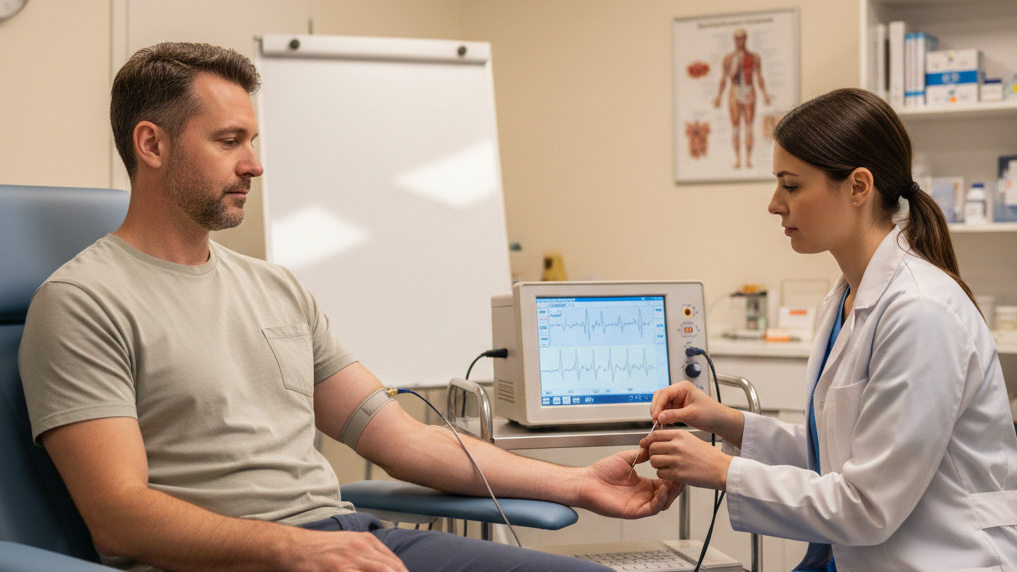
An Electromyography (EMG) test is often the missing piece of the puzzle. If you’re struggling with persistent pain, your doctor might order an EMG for sciatica to assess how well your muscles and nerves communicate.
The test usually has two parts, starting with the Nerve Conduction Study (NCS). The technician applies small electrical pulses to the skin to measure how fast and how strong the electrical signals travel down your leg. If the signal slows down or weakens at a certain point, it tells the doctor exactly where the blockage is.
The second part is needle EMG, in which a very thin needle is inserted into specific muscles to measure electrical activity. When a muscle loses its nerve supply due to nerve root compression, it produces specific electrical patterns that the machine can detect.
An EMG test for radiculopathy helps doctors distinguish between a spinal problem and issues elsewhere, like a pinched nerve in the knee or foot. This level of detail ensures the diagnosis is correct before any invasive treatments.
When EMG Changes Treatment Decisions
The ultimate goal of any diagnostic process is to create a treatment plan that works. Once EMG results are combined with your physical exam and imaging, the path forward becomes much clearer.
For many patients, an EMG may show mild nerve irritation, and in these cases, aggressive surgery can usually be avoided. Instead, the focus shifts to targeted physical therapy and anti-inflammatory measures. However, if the EMG shows denervation – meaning the muscle is actively losing its nerve connection – it might signal a more urgent situation. In these cases, waiting too long could lead to permanent muscle wasting or weakness.
Accurate diagnosis also helps guide spinal injections. Instead of guessing which level is the problem, the doctor can use EMG data to inject medication precisely where the L5-S1 radiculopathy is occurring. This increases the injection’s success rate.
If you’ve been struggling with persistent leg pain, you deserve more than a generic label – you need to know if you’re dealing with a temporary muscle issue or a significant nerve problem. At LoneStar Neurology, we specialize in these advanced diagnostic tests. We don’t just look at where it hurts – we find out why it hurts.

 (84 votes, average: 4.65 out of 5)
 Loading...








I've given up... the stress her office staff has put me through is just not worth it. You can do so much better, please clean house, either change out your office staff, or find a way for them to be more efficient please. You have to do something. This is not how you want to run your practice. It leaves a very bad impression on your business.
Please, leave your review
Write a comment: